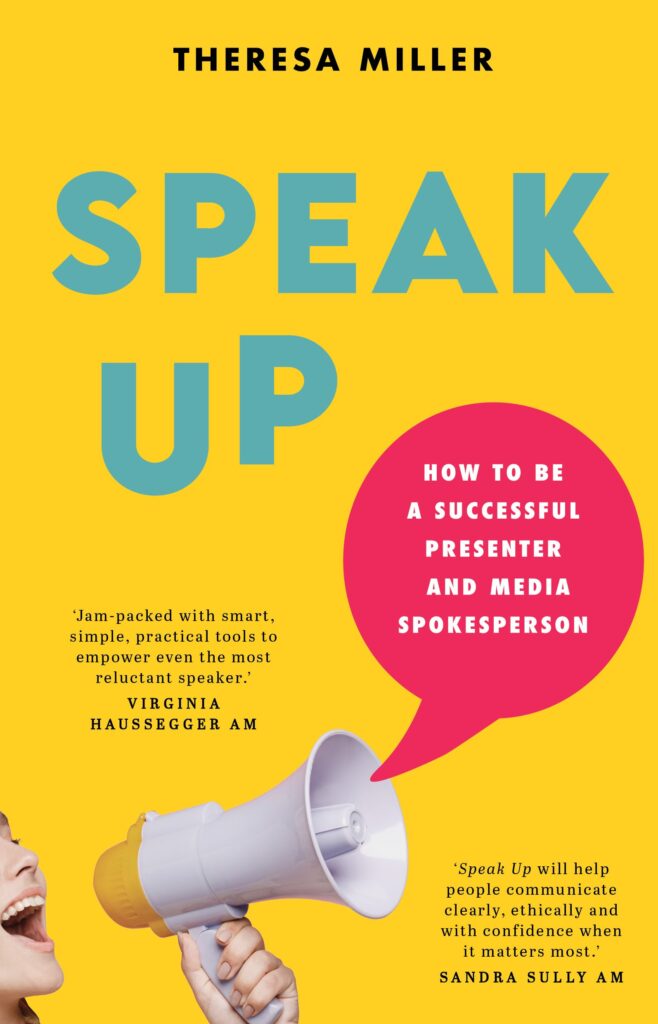


This is an extract from the book, ‘Speak Up: How to Be a Successful Presenter and Media Spokesperson‘ by Theresa Miller. Published by NewSouth Books, out now.
According to the recent Women in Media Gender Scorecard, only 30 per cent of expert sources quoted in news stories are women. That figure was less than half when it came to quoting experts in sport, motoring and defence. Men even dominated as media sources in industries where most of the employees were women, such as retail, health and education.
Women in Media is a registered charity representing women working in all types of Australian media, including journalism, PR, production and digital marketing. For several years, they’ve commissioned research to analyse almost 20 000 TV, radio and press news reports over a two-week period to understand how women are portrayed, featured and included as experts in their field.
Petra Buchanan, strategic adviser to Women in Media, says the scorecard is a wake-up call. “We want more women to be seen and heard in the media and called on for their expert opinions, comments and reactions to better represent the society we live in,” she says.
But it’s not just media interviews where women are less visible or audible. According to the founder of the Australian Women Speakers directory Jules Brooke, when corporate associations hire a speaker or MC for their business lunch or dinner event, they choose men over women 70 per cent of the time. That’s prompted a few savvy businesswomen like Jules to set up female-only speaker directories and bureaus.
So, if women make up 51 per cent of the population, why aren’t their voices making up at least half of the choir? An experienced Sydney-based lawyer told me she’d been invited to speak on radio about a significant case she’d been working on for months. She was the most qualified person to comment on its wider implications. However, she lacked the confidence to speak on live radio, so she declined the invitation. Instead, her junior male colleague jumped at the chance. The next morning, when she tuned in to the interview, she was shocked to hear him covering up sizeable gaps in his knowledge with vague generic statements and outright inaccuracies. But he sounded self-assured and unflappable. Back in the chambers, the young man was heralded as a hero. The senior female lawyer learned a valuable lesson that day and vowed never to pass up another opportunity to speak about her work again.
But it’s unlikely the gender visibility gap is due merely to a lack of confidence. While Gen Z girls are being encouraged more than ever before to speak up at home, university and work, they are rarely sought out for their opinion or comments by traditional media. Then again, neither are young men.
A 2019 research report found only 11 per cent of news stories included the views or experiences of young people. Usually, their inclusion was through adult mediators such as parents, police or experts. And just 1% per cent of news stories directly quoted a young person. The study funded by the Museum of Australian Democracy, Google Australia and Western Sydney University analysed almost 300 news stories across eight national, state and regional newspapers, plus four national and state television news bulletins, during a week. No wonder young people feel disconnected from mainstream media.
I spoke to 26-year-old Toowoomba-based News Corp journalist, Jessica Klein, about how she felt writing for a medium her friends don’t read or that doesn’t include their opinions. “I think one of the main reasons young people don’t engage with traditional media is it doesn’t really resonate with them. In traditional media, when we’re reporting on young people, we’re reporting about them, not with them. It’s always adults talking. It’s never their point of view,” Jessica says. “Young people also think there is some sort of agenda with traditional media. Another thing is their short attention spans. If it’s not a 10–15-second video, they’re probably just going to keep scrolling.”
In 2024, Klein won the Caroline Jones Women in Media Young Journalist’s Award. Besides reporting on local news and court stories in the Southern Downs and Granite Belt area of southwest Queensland, she’s written extensively on regional social justice issues, including homelessness and domestic violence. She’s interviewed inmates at the women’s jail near Gatton and reported on mistreatment in an aged care centre. It’s a shame so few of Jessica’s friends read her award-winning stories in the Warwick Daily News and Toowoomba Chronicle. In a bid to capture a younger audience, News Corp has posted some content on social media, a point Jessica impresses on her peers. “I try to encourage them to at least participate in some sort of media. You can still absorb news in a 30-second TikTok video or Instagram reel. But it’s rare that I see anyone under the age of 30 engaging with any of our content.”
Jessica is also encouraging the Warwick Daily News to create more posts that aren’t behind a paywall to attract younger eyeballs. “It’s definitely something all newsrooms could improve on, because today’s young people are going to be our next generation of leaders. So, we want them to be as best-informed as they can be. We need to engage them now, so when they’re older, they’ll still want to participate.”
Twenty-six-year-old SBS digital video producer Pranjali Sehgal agrees. “Gen Z and millennials are not watching TV. They’re going to digital sources because their phone is in their hand all the time. It’s where they live and breathe, it’s what’s natural to them,” she says.
According to a 2023 research paper by the University of Canberra’s News and Media Research Centre, news avoidance is high in Australia compared with other similar countries, but it’s particularly high among young females, with 72 per cent of Gen Z women avoiding news, compared to 67 per cent of men.
One news platform that’s plugging the gap is Missing Perspectives, which reaches more than a million young women every month through their podcasts, newsletters, videos and social channels. Two of their content creators even scored invitations to the federal budget lock-up in Canberra in 2025. Two other prominent podcasts with a similar mission are It’s a Lot, presented by former reality TV show star Abbie Chatfield, and Big Small Talk, hosted by Hannah Ferguson and Sarah Jane Adams. The latter’s tag line is: “Because, if you haven’t realised, loving pop culture doesn’t mean you don’t understand politics.”
Twenty-four-year-old Hannah Ferguson told HerCanberra Magazine: “I see myself as a commentator, not a journalist, not a lawyer, and not someone who’s an expert in women’s rights issues – I’m someone who sees a complex issue and knows how to communicate it simply with people. That’s my passion.”
The podcasts and their associated YouTube and social accounts have more than a million followers, capturing the younger demographic in a way that mainstream Australian media can only dream of. This hasn’t escaped politicians’ attention either. In the 2025 election campaign, Prime Minister Anthony Albanese was interviewed on both podcasts. Abbie Chatfield spoke to him for 90 minutes on a variety of topics, from climate change to his engagement to Jodie Haydon. She also interviewed former Greens leader Adam Bandt.
During the same period, SBS hosted an online debate between six popular political social media influencers on a range of issues from housing affordability to climate action. No matter what your views, their level of passion and energy was kilowatts above the prime minister’s and the opposition leader’s televised debates.
In researching this book, I spoke to several young journalists and youth-focused news content creators. They display curiosity, drive and chutzpah and seem prepared to ask the awkward questions many older journalists ignore.
So, while there are now more alternative platforms to amplify the voices of women and young people, there are still others who we rarely hear from. Research in 2022 by Media Diversity Australia revealed that 80 per cent of the television news and current affairs presenters on the free-to-air networks were Anglo-Celtic. The Who Gets to Tell Australian Stories? report found only 6 per cent of on-air talent are from a non-European background, even though they comprise 25 per cent of the population.
SBS digital video producer Pranjali Sehgal says traditional media often stereotypes people from ethnic backgrounds rather than seeking them out for their expert opinions or giving them a voice on issues that affect all Australians.
“Young people and multicultural communities are often pigeonholed into certain narratives when they’re so much more than that. They’re professors, they’re experts, they’re people with lived experiences who can speak about what they’ve been through. Their perspective is very much missing from mainstream media,” she says.
Sehgal says when journalists don’t seek out these communities for comments, it only compounds old tropes. “It not only lowers the representation of young people and multicultural communities advocating for themselves in the media, but it also doubles down on the perception that these communities aren’t engaged. They’re not given the opportunities and platforms other people take for granted,” she says.
When she’s not working at SBS, Sehgal is the head of media for Raise Our Voice, an organisation aimed at involving young people in politics and democracy through education, campaigns and communities. Sehgal is optimistic that perspectives are shifting in the media and society in general.
She says if you feel your expertise is being overlooked because you’re young or have an ethnic background or disability, she recommends building your profile through LinkedIn or other social media, blogging or podcast channels. Sehgal also suggests reaching out to the media to let them know you’re available to speak as an authority on a specific topic if the opportunity arises.