


Last night, Academy Award-nominated Black actors Michael B. Jordan and Delroy Lindo were called the N-word by a white man with Tourette Syndrome (also referred to as Tourette’s) while they were on stage at the 79th British Academy Film Awards (BAFTAs). The racial slur was shouted by John Davidson, a Tourette’s advocate who inspired the BAFTA-winning film I Swear, who has since apologised, explaining his tics are “involuntary”. If you’ve seen the clip, which was broadcast unedited and uncensored by the BBC two hours after it was filmed, you will have observed the devastating stillness of Jordan and Lindo — clearly shaken yet not unfamiliar with racism of this kind — following the humiliating insult hurled at them before their peers.
In that moment, Jordan and Lindo weren’t privileged Hollywood stars presenting at one of the most prestigious award ceremonies in the world, off the back of a record-breaking 16 Academy Award nominations for their highly successful film, Sinners, but rather men born into a lineage of people subjected to subhuman treatment under white supremacy. Their disappointment echoed in the hearts of every other Black person in the room or watching at home, who could relate to having a special moment violently intercepted by the harsh reality of racism.
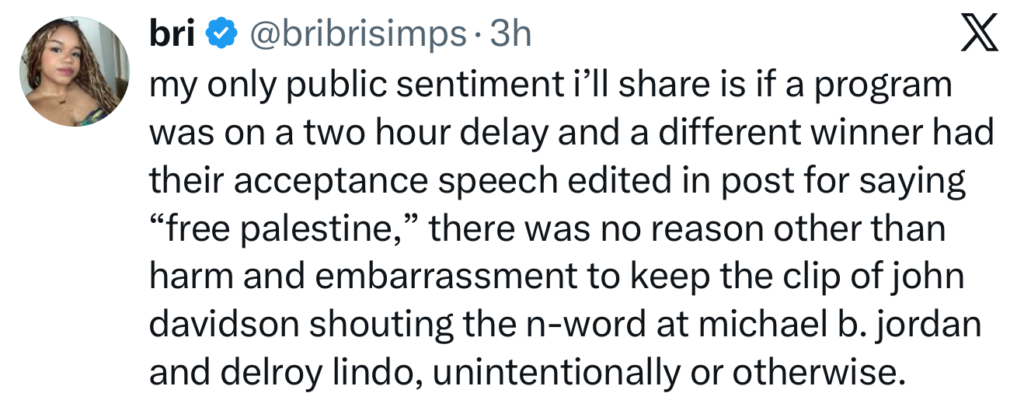
Soon after Davidson’s interruption at the awards, BAFTAs host Alan Cumming seemingly acknowledged Davidson’s use of the N-word (among other non-racial expletives), referring to it as “strong language in the background”, which could be attributed to his condition. He pre-emptively thanked the audience for their “understanding” and apologised “if anyone was offended”. This throwaway “apology”, alongside the BBC’s decision to air the moment, despite demonstrating their editorial involvement in post-production by removing political remarks such as “Free Palestine” from a winner’s acceptance speech, made it clear that the BAFTAs did not deem this moment offensive enough to name, let alone take accountability for. And in turn, it set the stage for internet discourse that was perhaps just as divisive and harmful as the slur that came out of Davidson’s mouth.
When news of this moment reached my timeline, I was heartbroken for Jordan and Lindo, and foolish enough to be surprised that neither BAFTA nor Davidson had issued an immediate apology or statement of solidarity. This left Black Twitter responsible, as usual, for educating others on why the awards show had failed Jordan and Lindo by failing to remove the interruption from its broadcast and not implementing safeguards against such racism if they had reason to believe Black guests would be at risk due to the nature of Davidson’s condition. Unsurprisingly, the very valid concerns of Black people were met with accusations of ableism from non-Black folks, and an insistence that Jordan and Lindo were not worthy of our collective empathy or respect. Some people even argued that it was ableist to expect Davidson, who had been silent until this morning, to apologise for his behaviour if it couldn’t be helped. Nevermind that the oversimplification of Coprolalia (a symptom of Tourette’s where there’s an involuntary outburst of socially inappropriate words) by the internet completely ignored the existence of people of colour living with the same condition, burdened by both ableism and racism.
I find Davidson’s presumption of innocence here problematic, particularly when his silence following the ceremony soon became louder than his interruption. It must be said that there is nothing inherently progressive about any identity, not mine as a woman of colour or Davidson’s as a disabled man. We should all be held to account for behaviour that harms others. Intent does not negate impact. Context provides insight, not justification. There are unavoidable limitations to my perspective on this matter as a writer who does not live with Tourette’s syndrome and benefits from proximity to whiteness as someone who is light-skinned and half white. I understood immediately that in having a reaction that was in any way critical of Davidson, as a non-disabled person, I risked being misunderstood and labelled an ableist. This fear, alongside the fear of speaking over more marginalised members of the Black community, meant I chose silence in the hours following the BAFTAs broadcast.
I have no desire to analyse the legitimacy or extent of Davidson’s Tourette’s, to demonise those living with the syndrome, or to minimise the very real impacts I’m sure ableism has had on his quality of life. I believe in inclusion. But I refuse to let acknowledgement of Davidson’s disability be at the expense of prioritising the wellbeing of the two Black men who were victims of his racist outburst (whether intentional or not), as much of the internet has. It wasn’t until later, speaking to my mother, who is not white, that I fully understood why this one moment, which did not directly involve me, triggered such a deep and ancestral pain. And I now feel obligated to speak up, not as the most marginalised or hard-done-to member of the Black community, but as a writer who cares deeply about the all-too-often-forgotten humanity of her people. Because that is the missing perspective here: that of Jordan and Lindo, and of the people who look like them, who are routinely denied recognition of their hurt and protection from others in favour of preserving white comfort.
Alan Cumming’s “apology” reminded me that every time I’ve ever spoken up against objectively racist things, there’s always been a good-intentioned white “ally” around me who made it obvious they would rather I didn’t. Witnessing two of our most accomplished Black actors be humiliated on a global stage was a vile reminder of the many moments I’ve entered into a room or a conversation assuming it was safe for me, only to be blindsided by the irreversible realisation that, above anything else, I represented a racial other whose presence was conditional on me playing the part expected of me. The laughable and noticeably late apology from Davidson, backed by a cowardly statement from Tourettes Action (a charity he is associated with), which never directly refers to Jordan or Lindo or makes mention of race or his use of the ‘N-word’, prove once again my belief that anti-Blackness is the great equaliser that unites groups of people otherwise separated by differences in class, gender, sexuality, and ability.
I resent the notion that Black writers, like myself, make everything about race and that in doing so, we’re attacking others. No one wants things to be less about race more than a non-white person; no group is more fixated on race than white people. Yet too many people ignorantly assume that race only enters the room when we do. And whether you draw attention to your race or not, if you live in this world as a person of colour, you can mostly rest assured that even when you forget your race, they won’t.
You can’t talk about your pain as a Black person without being accused of wishing to hurt others, whether it’s white people, people living with a disability, or any other group. You can’t talk about the institution of racism and the impacts of white supremacy without needing to make a distinction between whiteness and white people (look it up), as I often feel duty-bound to do. This is a tiring and vicious cycle that repeats itself and impedes progress.
I will never forget when I first discovered that famous novelist Toni Morrison described the “very serious function of racism” as “distraction”. “It keeps you explaining, over and over again, your reason for being,” she explained during a keynote address on race in 1975. “None of that is necessary. There will always be one more thing.” How are we to ever arrive at an anti-racist future if Black people are still burdened with explaining what racism is? With proving it exists? With campaigning for your attention and your sympathy?
The policing of Black Twitter’s upset over the incident at the BAFTAs brought my nervous system right back to 2020, the sickest year of my life, when my presence on the internet was focused on reaffirming the need to show support for Black people in the wake of George Floyd’s murder and the Black Lives Matter protests that followed. It was a hugely beneficial time for my career. I was a 19/20-year-old journalism student with a perspective hard to find in Australia’s predominantly white media landscape, well-versed in Black history and anti-racist theory, and skilled at keeping white audiences on side while talking about race. Yet the weight of the experience left me with crippling anxiety and depression, chronic illness, and reliant on SSRIs to come out the other side of a nervous breakdown.
@tatyanaarrington The BAFTAs are wrong #baftas #michaeljordan #delroylindo #awardshow #sinners #tourettes ♬ original sound – tatyanaarrington
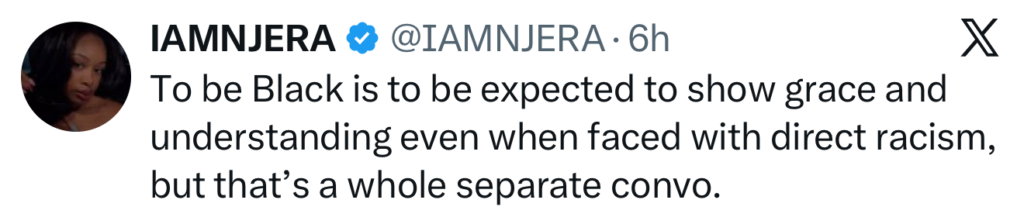
Racism never dies; it simply reinvents itself. To absolve perpetrators of guilt, part of racism’s rebrand post-Civil Rights movement has involved projecting a superhuman strength and resilience onto Black people. Black people dealing with racism are asked over and over again to be the bigger person, to go high when they go low, to be the picture of grace and civility even when their livelihoods are threatened. Our unbreakable spirit is mistaken for permission to cause harm. By refusing to die at the hands of Slave owners and Klansmen, we somehow suggested there was no limit to the cruelty we as a people could endure. Our ability to respond to adversity with resilience and even humour, rather than breaking down or showing “weakness,” is a necessary skill passed down through generations, not an endorsement of the hatred and exclusion we’re made to rise above. We shouldn’t need Jordan or Delroy to make visible their presumed pain for us to take issue with their public degradation. If Jordan and Delroy (who says he wishes someone from BAFTA spoke to them afterwards) have failed to earn our collective empathy and kindness, even while choosing not to draw attention to Davidson’s racist interruption, could you imagine the response of the public if they had justifiably responded with anger?
The work of Audre Lorde, another Black writer and professor, should remind us all that anger is an appropriate response to racism. Anger is not a moral failing of Black people; it is brought into being by oppression. For this incident to have occurred during America’s Black History Month is a reminder that we are still reckoning with the legacy of our racist pasts despite the enormous strides we have made towards racial justice. Jordan and Lindo are privileged to have only been exposed to “unintended” verbal assault, which looks like child’s play, compared to the very intentional physical violence many of our ancestors endured.
Still, that privilege was secured by the work of those very same ancestors, who refused to accept the racism of their time even when it was downplayed by others. My experience of Blackness is not one of victimhood or suffering; it is a source of joy and richness for my family and me. I am proudest of being Black because it aligns me with a culture and history defined by unparalleled creativity, genius, intellect, courage, compassion, and strength. But as always, I owe it to my ancestors and their communities to continue their work until racism isn’t considered an unavoidable fabric of our multi-faceted existence as Black people.