


What do you think of when you hear the word philanthropy? Maybe a hospital wing with a donor’s name or Bill Gates. Probably not a zillennial named Bri, living in a sharehouse, trawling op shops and wondering if she can justify the cost of an almond croissant.
So how then do I have hundreds of thousands of dollars to give to charity?
Well, I don’t. But myself and 600 others collectively do.
In June 2024, I founded Five Bucks. The idea is simple: every member chips in $5 a week. We let the pot grow for 12 months and then we give it all away through a democratic voting process (yes, we use preferential voting… very fair, very Australian).
In our first year, we raised and granted $62,000 to four incredible organisations working to protect people and the planet. In just over a year, we’ve grown to 600 members, putting us on track to give at least $130,000 by June 2026 – more than double our first year.
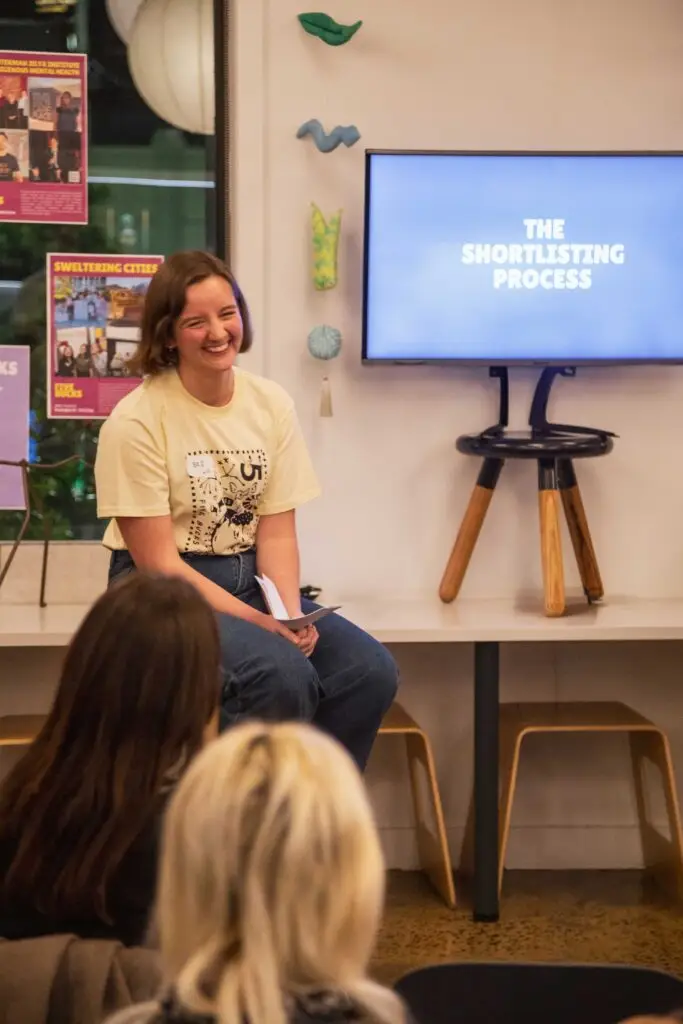
So while many of us wouldn’t even think of calling ourselves philanthropists, the truth is this: we are.
Five Bucks is disarmingly simple. But beneath the surface there’s a much deeper story about community, generosity and rewriting the rules of who gets to participate in change.
I grew up in Cooma, on beautiful Ngarigo Country. We didn’t have much – and by much I mean money – but I was surrounded by generosity, people who shared what they had. My mum was the sort of person who’d go without, so someone else didn’t have to. Those early years taught me that generosity isn’t about wealth; it’s about instinct and heart.
Being the first in my family to go to university was a big deal. I studied Development Studies and Media at UNSW, which sent me working all over the world and eventually led me to co-found Kua, a social enterprise supporting smallholder coffee farmers in Uganda. Over five years, the team and I started, scaled and sold Kua. Along the way, I worked with the Centre for Social Impact and the World Bank, and somehow squeezed in a Masters in Human Rights at the University of Sydney.
It was a huge half-decade, full of lessons, but one stood out: never be afraid to question the rules. So many norms we take for granted – rugged individualism, rigid hierarchy, profit above all else, ‘the way things are done’ – but most of them don’t actually serve us. Suggesting and then testing alternatives is essential if we’re going to tackle the big, hairy problems of our time.
Last year, I was shocked to learn that the number of Australians choosing to donate to charity has been declining for more than 15 years. And compared with countries like the UK, US, Canada and New Zealand, we give significantly less.
So in 2024, I asked 159 Australians aged 23 to 36 about their giving habits. From this, I learned 4 in 5 wanted to and had capacity to give, but most weren’t. Why? As you’d expect, nearly two thirds cited competing financial priorities. But just as often, people talked about compassion fatigue, overwhelm, distrust and good old-fashioned procrastination.
It turns out people weren’t holding back because of money alone, but because of mental and emotional barriers too.
The survey left me wondering: what if giving felt more accessible, more routine -– something we all got around? Could we create a new kind of philanthropist in Australia, one centred on the collective, not the individual?
My hope for Five Bucks is that we inspire a movement where chipping in becomes part of the culture; where every Australian, regardless of wealth, can see themselves as an agent of change.
Top photo – pictured: Brianna Kerr, Source: Supplied