


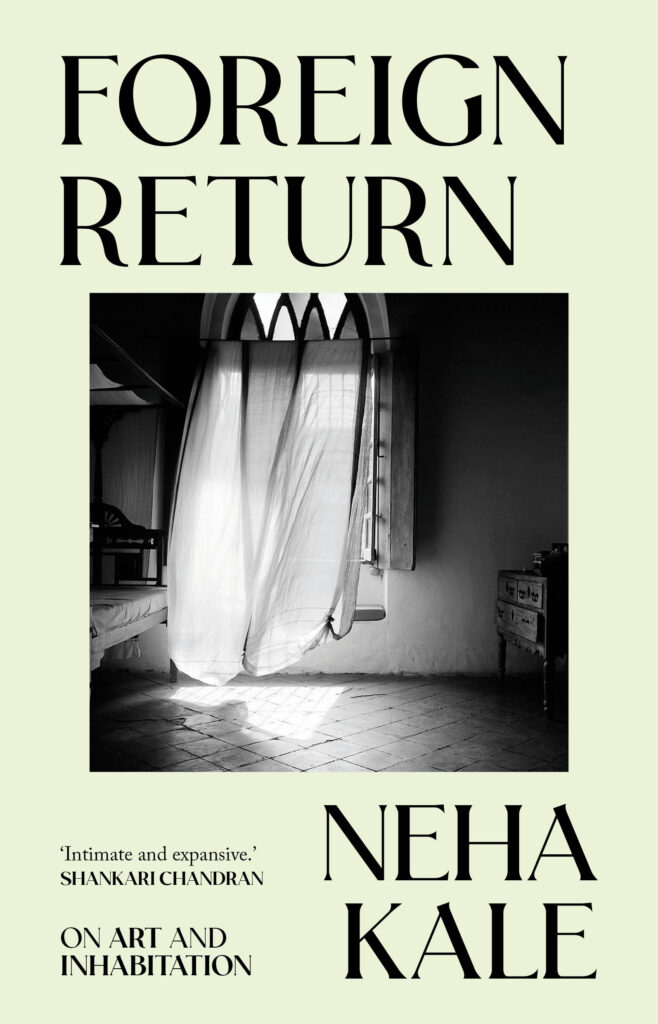
Missing Perspectives journalist Sunny Adcock spoke with Neha Kale following the release of Foreign Return to discuss the book’s thesis, how migration is a human act (vilified by reductive stories in the media), how art can articulate the unsayable, and why home is something you carry with you. Note: The following interview has been edited for clarity.
You migrated from India to Australia at a young age. You call the move “unremarkable,” yet the narrative underpinning Foreign Return is deeply grounded in your upbringing in India (note: Neha grew up in Bombay, her ancestral house, and spent a lot of time as a child in Goa) and your subsequent travels around the world. How do you reconcile this?
I was interested when writing Foreign Return in the extraordinary questions that can run under the surface of an ordinary life and the way in which movement and migration are deeply human experiences. The word migrant comes from the Latin ‘migrare’, which means to move or change places, and migrants—whether they are fleeing violence or seeking a more certain future—have always left their original homes to make lives elsewhere. But the contemporary conversation casts migration as a new phenomenon. This idea is completely misinformed, which I think allows migrants to be reduced and demonised, cast as interlopers or invaders in the national imagination. In Foreign Return, I wanted to write against this by showing the reader that the act of migration—increasingly reviled by our culture—can be creative and generative.
Your book arrives at a moment when anti-immigrant sentiment in Australia feels higher than ever. At best, the migrant experience is used as resilience porn and at worst, high migration levels are being blamed for social division and economic instability. You write against those reductive stories, but if you had to articulate the thesis of Foreign Return in one sentence, what would it be?
This is such an astute question. I’ve always felt uneasy at the way in which the migrant, in the Australian imaginary, is framed either as a model minority, accepted only for contributing to or enriching the culture or as a drain on the country’s resources, responsible for everything from crime to the housing crisis. For most of my life, I had been taught to aspire to the first path. But both paths undermine our freedom and dignity, the right to be human and vulnerable in all its messy complexity. Both paths also centre the idea of belonging to a country that still hasn’t reckoned with the brutality of its own history —and that, as we’ve seen over the last few years, is shaped by the moral apathy of the West.
I am often struck by how the way we talk about home on this continent is defined by entitlement and ownership, and actually, how this parallels the way in which this nation, as well as its public and private spaces, perceives women’s lives and bodies. I was thinking a lot about what it would mean to understand home through the lens of our responsibilities to people and places, to what we owe each other. So if Foreign Return has a thesis, home as relation, not possession, would be it.
There’s a tension in the title itself, Foreign Return, between leaving and coming back, between being foreign somewhere and being foreign at home. For you, is home something you find, something you build, or something you carry? Has writing this book changed your answer to that question?
All three! We think of home as something we inherit, but—whether we are talking about legacies of colonial violence or other difficult or contested histories—inheritance can be ethically fraught. And as our world becomes shaped by ecological and political fracture, this idea of foreignness—which I play with in the book—is relevant to everyone. We are increasingly strangers in a strange world, unmoored from all that is familiar. Writing this book, I realised that home is no longer about departure or arrival, but about how you carry your lost homes with you, and how—in relation to other people and the world around you—you keep finding, keep building a version of home that is meaningful, that hopefully endures.
You move between Perth, Sydney, Melbourne, London, Bombay and Mexico. How did choosing these specific cities shape your thinking about home? What did each place teach you that the others couldn’t?
I’ve always been fascinated as a writer by the way different places can give rise to different selves. For instance, in Sydney, there’s something about the landscape—the proximity to the ocean and water, those flashes of subtropical beauty —that encourages an outward gaze, with the natural world always part of your psyche. In London, you can’t help but perceive the smallness of your life against the flow of time, the thousands of other people who have made homes in the metropolis; and in Bombay, amid the wildness of that city, its churning capitalist engine, I am reminded again of the power of ritual and devotion to what you can’t see but is somehow still there.
Art is threaded through the book — Dayanita Singh, Brett Whiteley, Francesca Woodman, Carol Jerrems, Albert Namatjira. For readers unfamiliar with your work, can you walk us through how you use art to access these ideas? What is it about a particular artwork that can unlock something about home that prose alone can’t reach?
In Foreign Return, my narrator is a colonised subject who ends up making a life on stolen land. She no longer has access to her lineage or culture, but can feel this absence under the surface of everyday life. From the photographs of Dayanita Singh and their evocations of time and memory, to the paintings of Brett Whiteley and their masculine visions, to the watercolours of Namatjira, with their reverence for Country and place, the art in the book addresses the narrator’s gaps in knowledge and her understanding of herself and the world. It also articulates the unsayable, what words can’t.
You’re writing about deeply personal, intimate spaces and their relationship to belonging and identity during a housing crisis and a moment of rising anti-migrant sentiment. How do you hold the personal and the political together in this book? Did you feel a responsibility to address those larger forces, or did the personal lead you there organically?
I’ve always believed, as a writer, that the more specific you are, the more universal you are. In writing Foreign Return, I wasn’t interested necessarily in ‘telling my story,’ which I don’t think is that interesting, but in showing how individual lives are caught up in forces so much larger than them, subject to history and time. On a craft level, I accomplished this by thinking about a piece of advice from a writer I greatly admire, the American essayist Eula Biss, who talks about the act of writing through your life rather than about your life—to use life as material to wrestle with the question of not where home is, a question that I feel is increasingly irrelevant, but what it can be.
Very early on in your book, you write that “memories, slippery or otherwise, get truer every time you retell them”. I’ve always believed that each time a story is retold from memory, its vividness fades. It’s like looking at a picture of a picture. You start to remember a memory or your last retelling rather than the original moment. You don’t agree. Why?
Your perspective on this is so interesting! I was really interested, when working on the book, in the power of memory as an imaginative space, a landscape that you can visit in your head. When so many of the places and homes that we love are lost, I wanted to make a case for the legitimacy of memory as a kind of home. This home can’t be measured in terms of its economic value, that is, in fact, useless to the capitalist and neoliberal society we live in—but is more significant because of it.
With memory in mind, you write about this idea of restorative nostalgia. In the epilogue, you speak of that emotion “spreading like a sickness”. Can you explain what this means, and do you think that leaning on nostalgia during times of difficulty is more of a help or a hindrance?
In the first chapter of Foreign Return, “Moving Pictures”, where I return to my ancestral house in Goa, I explore the appeal and dangers of nostalgia – how the migrant’s desire to return to some pure version of home so often mirrors fascist and racist rhetoric, the delusion of an uncontaminated world. By the end of the book, which is set in an America that plays host to ICE Raids and a border crisis, and an Australia where parties such as One Nation enjoy growing power, this nostalgia—which I believe is sparked, too, by a desire to return home has proliferated, engulfing the culture. I think nostalgia is both a natural human instinct and a dangerous force, and it is important to be wary of it, especially right now.
What’s next for you?
I’ve spent the last three years working on this book, so I’m enjoying taking writing and life a little bit more slowly, and enjoying some rest. The idea for a new project has been taking shape over the last few months, but I’m mostly excited that Foreign Return is finally out in the world, and by the privilege and honour of a book I’ve been holding in my head hopefully connecting with readers.