


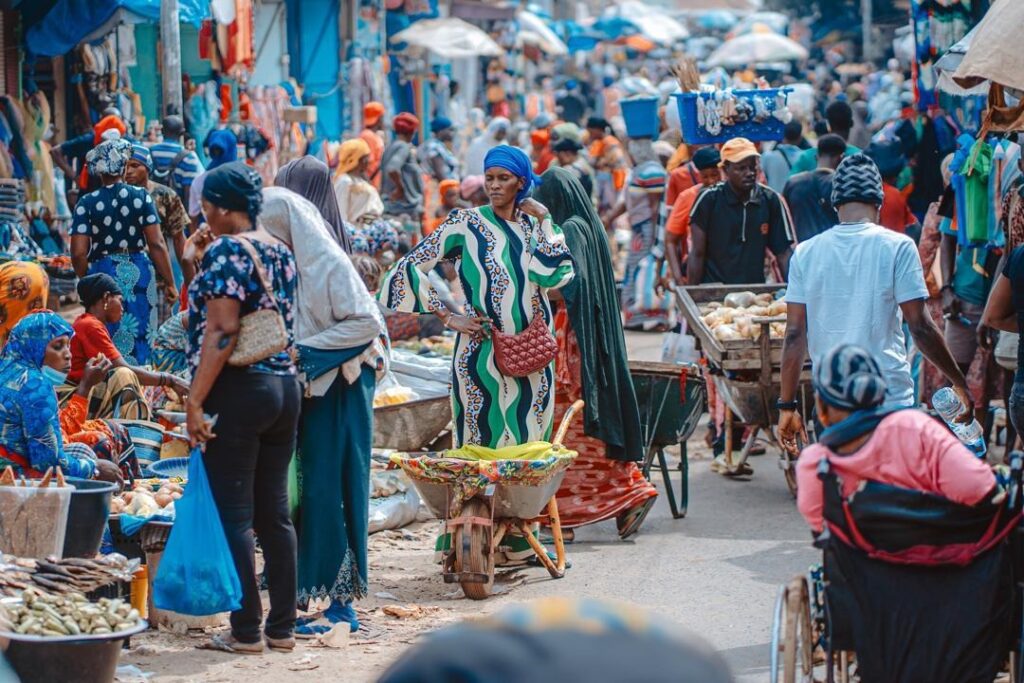
As the sun rises from the east, Mba Jankey Ceesay steps out of her home in Jalambang – 44 kilometres away from Gambia’s capital Banjul – balancing a basket of cassava leaves on her head. Her children are still preparing for school and her husband, too ill to work, stays at home.
She walks little by little to Brikama Market in the regional capital of West Coast Region, each step heavier than the last. By the time she sets up her small stall, the sun has climbed higher and the heat wraps around her like a weight she cannot shrug off.
“When the sun is too hot, my body feels weak. I experience body pain and fever often,” she says, while fanning herself under the umbrella she uses as cover. “Sometimes I leave the market early without finishing my sales because I can’t stand the heat for long.”
Mba Jankey’s struggle is intertwined with family responsibilities. She is a mother of five and three of them attend school. With her husband sick, she shoulders the burden of taking care of the family through selling food products. She knows they need help but has since come to terms that the government wouldn’t come to their rescue.
“Even when we talk, the government does not come to our rescue. God knows we need help, not only me, but every seller here,” she says.
Women vendors selling their products at the Serekunda Market. Photo: Supplied
Jankey’s tale isn’t unique. Fifty-year-old Awa Ngum, who has spent 26 years selling fish at the largest market in The Gambia Serekunda Market, says the extreme heat makes her daily routine exhausting.
“When it is too hot, we face difficulties and health complications. This heat does not spare anyone,” Ngum says in a soft but firm voice. “I have lost weight completely. I am drained. Sometimes, while selling, you see someone collapse. I used to have only high blood pressure, but now I have diabetes. This heat has made me sick on several occasions.”
Ngum uses an umbrella as a cover but the effects of the sun are unavoidable. She says when the heat is high, her diabetes and high blood pressure start to attack her. And falling sick affects her source of income as she stays at home rather than going to the market to sell.
“We would be pleased if we could have assistance to resolve the issue,” she adds, looking around at the other vendors enduring the harsh sun.
Like Ngum, Haddy Njie is a fish vendor in her fifties grappling with the current heat conditions. She says the heat gives her fever and her heart keeps pumping fast. In a bid to ameliorate the situation, she would buy cold water, drink some and pour the rest over her face and head.
“Even with the umbrella, it is still challenging because when it gets overheated, it still affects us. We need assistance to take care of our health,” Njie says.

Modou A. Njie, Serekunda Market Manager, explains that while the council provides allocated stalls and umbrellas, many women leave their stalls to sell on the streets, exposing themselves to the sun. He says despite efforts to distribute umbrellas, nearly 200 last year, the problem persists and that clearing the streets often requires coordination with the police.
“On my patrols, I see women struggling with high blood pressure or other issues caused by heat,” he says, adding women seldom report their conditions. “Sometimes vendors even rest or sleep during the heat.”
Disruption of economic gains
Gambian women vendors endure physical and emotional struggles daily, battling with their own bodies to keep supporting their families while navigating the oppressive heat, limited infrastructure, and the constant worry that illness could interrupt their livelihoods.
Business activity also suffers under the oppressive heat. The market slows, income drops, and women are forced to balance their health against the urgent need to provide for their families.
Dr. Sunkaru Touray, MD pulmonologist and critical care physician, says the effects extend beyond health, explaining high temperatures reduce the time people can spend on economic activities. And for women vendors, this directly translates into lost income, creating a cycle of vulnerability that is difficult to break.

Dr. Sunkaru Touray, Pulmonologist and Critical Care Physician, Permian Health Lung Institute, The Gambia. Photo: Supplied/Dr. Sunkaru Touray
Speaking on health implications, Dr. Touray explains that extreme heat can overwhelm the body’s ability to regulate temperature. He says prolonged exposure can cause heat rash, cramps, and heat exhaustion and women working long hours in markets or agriculture are particularly at risk.
According to him, historical data show that The Gambia’s average annual temperature has risen steadily since the 1950s, with the harshest heat occurring between March and May during the harmattan season. Severe dehydration and electrolyte loss can lead to hospitalisation or death.
“We have seen fatalities, including a tourist who died from heat exhaustion at The Gambia airport,” Dr. Touray recalls.
Urbanisation is also compounding the problem. Touray says cutting down trees and paving roads create a heat island effect.
“Green spaces in cities are essential to reduce the health risks associated with extreme heat,” he explains, urging planners to consider the human cost of climate adaptation in urban spaces.
A global health issue
Dr. Yahaya Idris, a PhD Candidate from the Medical Research Council Unit The Gambia at the London School of Hygiene and Tropical Medicine (LSHTM), says extreme heat is now recognised as a global health threat, but its impact on women, especially those who work outdoors, is often overlooked.
“Extreme heat is a global health issue posed by climate change. Pregnant women and their fetuses, outdoor workers (farmers, traders), especially those who work for long periods under the sun, are particularly vulnerable,” he says. “Health inequity already exists worldwide. Africa, especially Sub-Saharan Africa, has been identified as one of the most vulnerable regions to the impacts of climate change.”
According to him, the immediate effects of extreme heat include tiredness or fatigue, as well as profuse sweating. With continued exposure, the victim (women in this case) may become dehydrated, which happens when they lose more fluid than they take in, and this could result in an electrolyte imbalance, which then presents as heat cramps (painful involuntary muscle spasm). If not addressed, these earlier presentations can progress to heat exhaustion, marked by tiredness, fatigue, headaches, and related symptoms. In more serious cases, women may experience heat syncope (dizziness, fainting) and, the most severe clinical presentation at the end of the continuum, “heat stroke”- which is a medical emergency that needs prompt intervention.
“Heat stroke occurs when someone is exposed to temperatures of 40 degrees Celsius and above – signalling failure of the body to regulate temperature,” Idris says, adding people may then suffer confusion, seizures, and even loss of consciousness.
Long-term consequences can be equally serious. Idris says repeated dehydration and volume loss in the body can predispose to acute kidney injury and kidney stones, while in the long run, if these are not properly addressed, they can progress to chronic kidney disease, which may require dialysis. Extreme heat, he went on, also affects the cardiovascular system as growing studies are unfolding, particularly during pregnancy, when fluid levels naturally rise.

Dr. Yahaya Idris from the Medical Research Council Unit The Gambia at LSHTM. Photo: Supplied/Dr. Yahaya Idris
In earlier research conducted in The Gambia, Ana Bonell et al found that both pregnant women and their fetuses experience heat strain during outdoor work in extreme heat. “When exposed to heat stress, the body responds by increasing blood pressure and heart rate (physiological strain), both in the mother and the baby,” he says.
The study also showed a kind of placental compromise, where the volume of blood reaching the placenta is less than it should be. These changes are probably linked to poor pregnancy outcomes, which is one of what their ongoing new study is investigating. Idris said extreme heat increases the risk of stillbirth, preterm delivery, and miscarriage. He adds that there is some emerging evidence of congenital anomalies, though it is still limited.
“Pregnant women exposed to high temperatures are also more likely to develop pregnancy-induced hypertension and gestational diabetes studies have reported,” he says.
Dr. Idris notes that extreme heat worsens existing illnesses and places pressure on health systems, especially in regions already experiencing other compound effects of climate change, such as drought, flooding, food shortages, and the impact on infectious diseases such as malaria and dengue. To reduce the risks, he says women and communities can take scheduled breaks during work under the sun, rest in shades, stay hydrated, wear light and light-coloured clothing, and work during cooler hours of the day. At the community level, he calls for the planting of trees and awareness campaigns while suggesting that governments ensure effective responses, including forecast and alert systems and public education.
Law in the making
Plans are afoot to introduce a law that will address a wide range of climate issues and provides stakeholders with the authority to enforce regulations in urban areas. Without such legislation, Omar Sey says implementing and enforcing initiatives would be difficult. Sey is the Director, Technical Service Network at the National Environmental Agency (NEA). He says the Government of The Gambia through the Climate Secretariat under the Ministry of Environment is working on a climate change bill which had its first reading on 19 November 2025.

Omar Sey, Director Technical Service Network at the National Environmental Agency (NEA). Photo: Supplied
The agency monitors air quality and highlights heat-related concerns when necessary. NEA operates three monitoring stations that track particulate matter, including PM2.5 and PM10 levels, providing critical data for environmental and public health planning.
He states that the NEA is piloting urban greening initiatives. Numerous seedlings have been planted and supported by one of their projects, and the idea is to ensure these seedlings or trees are taken care of to maturity. This, he says, will reduce the heat within communities and create spaces where vulnerable individuals can rest safely.
Top photo – Pictured: Women selling fish at the Brikama Market exposed to the sun’s heat. Source: Supplied