


Despite my misgivings, I went into Wuthering Heights with an open mind. It was unlikely I could fully enjoy a film that proudly strips itself of its source material’s core thesis, but I was willing to see it on its own terms out of curiosity, more than anything. I’m not a purist when it comes to adaptations, and I’m not a stickler for historical accuracy, either. Mostly, I just wanted to see some freaky shit.
So, armed with this reluctant optimism, I actually found the start of Wuthering Heights to be promising. In the opening scene, we see a gruesome public execution of a man who has an erection visible under his clothes, which a nun eyes in quite an unholy manner. Young Catherine Earnshaw watches his suffocation (and ejaculation) with zealous, almost rapturous excitement. A couple have sex nearby, and later, we see Catherine gleefully and viciously stab rats trapped in a barrel. Love, death and ecstasy are presented as inherently intertwined.
Upon returning home, Catherine — a budding sociopath, it seems — is presented with a boy her father has picked up from the port to be her “pet”. She is the one who names him Heathcliff, her ownership and possession of him begins. However, it’s here that Heathcliff’s whiteness is confusing. Canonically, he’s treated as inferior to the Earnshaws because of his racial background (he was picked up at a port known for trading slaves). Omitting this detail from the film feels odd: why else would an aristocratic, Aryan-looking girl declare Heathcliff her possession if not in a context where his people are considered property? The story doesn’t make sense with Heathcliff as a white man.
But, as I’ve written about previously, Emerald Fennell has always had a problem with sticking the landing. I was compelled by the interpretation of Cathy as a violent sociopath who experiences arousal at the sight of death, but this is never followed up on: fast forward to when she and Heathcliff are adults, and Cathy is bitchy and morose, sometimes a little cruel, but mostly kind-hearted. When she does lash out, it’s often out of petty jealousy and control issues, nothing one can’t relate to. What happened to all the rat-killing execution horniness? In fact, what happened to the “taboo” in general?
The white supremacy of it all
Emerald Fennell has defended her casting choice in this film by saying that this is how she imagined the characters when she read Wuthering Heights as a teenager — the quotation marks in the adaptation’s title are supposed to indicate a dreamy, misremembered and romanticised interpretation. Or maybe they’re a convenient way for her to justify the film’s departure from the source material. Either way, they lose their power when you take five minutes to consider how Fennell’s background and internal biases might influence her characterisations.
I find it highly suspicious that Heathcliff is whitewashed and Cathy is turned into a blond, blue-eyed bombshell while Nelly (Hong Chau) — now conniving, traitorous, scheming and subservient — is reimagined as Asian. She’s the only woman of colour in the film, and it’s her anger that ultimately kills Cathy. Meanwhile, cringe, impotent, overeager Edgar (Shazad Latif), who is too cowardly to confront his wife’s infidelity, is reimagined as Indian. It reminds me of Fennell’s sophomore film Saltburn, which also handles its one person of colour clumsily, if not outright offensively.
Book reviewer Sanjana Basker said it best when she wrote in an Instagram Story: “Fennell just never seems to have anything to say except for, maybe, striving and ambitious middle class people are scary and not to be trusted because they will try to take you down if you are wealthy and pedigreed and beautiful lol.”
Where was the freakery?
Wuthering Heights was marketed as steamy and erotic to the point of squeamishness, complete with cracked eggs and fingered fish, but, perhaps unsurprisingly, Fennell fails to follow through.
While Cathy is in her teens in the book, Fennell’s Cathy is an adult and considered well past the age of a “spinster”. Somehow, we’re supposed to believe she has her sexual awakening in her 30s, with no backstory explaining why this is or what she was doing in previous years.
Heathcliff, for his part, is described to us on numerous occasions as being monstrous and terrifying, but no evidence is presented to back this up. The lack of fiendish behaviour makes the apparently toxic part of their relationship confusing. As writer and editor Heather Parry puts it, “Because he is so denuded as a character, the taboo of Cathy’s desire for him is totally de-fanged.”
“He is not a man who abuses and perhaps rapes the innocent Isabella, having murdered her dog as a ‘gift’ on their wedding day; instead he is a bitchy consensual Dom with a wandering accent,” she writes. “Catherine is not a genuinely torn girl who understands the workings of the world and is still corrupted by them; she is innately mean and stupid, obsessed not with a monster but with a sort of sad goth ruffian.”
And so the question is: why do we care about any of it? Because it’s sexy? Well, even that isn’t quite the case.
Most of the sex scenes between Cathy and Heathcliff are shown to us montage-style, stripped of individuality and presented as almost generic. And then there’s the odd and slightly prudish detail of Cathy and Heathcliff being fully clothed during these scenes. Sure, nudity isn’t necessary for an erotic scene to be steamy, but after the recent wave of slut-shamey puritanism in pop culture, it’s certainly an odd choice.
The only interesting, and by extension, good sex scene in “Wuthering Heights” is when Cathy brags to Heathcliff about sex with Linton. Heathcliff, clearly into this degradation, has her continue to praise Linton while he fucks her on a table. It’s the only sex that feels real in this movie because it feels specific to the characters and their personalities. There’s an intimacy in this provocation, this trade of barbs, that only they understand. The sex scene tells us something about who they are and how they interact, something Fennell is generally bad at. And it’s not even that kinky!
In fact, the only true freakery in this disappointingly vanilla film comes from the Lintons.
Edgar Linton paints the walls of Cathy’s room the same shade as her skin (complete with disturbingly realistic veins and freckles) because it’s his favourite colour. It’s clear by Cathy’s nonplussed reaction that we are meant to find this weird and a little off-putting, but all I could think was finally, this is the kind of perverse devotion I’m looking for. I wanted a weird, down-bad, slightly unhinged romance — and I think it’s a testament to the confused nature of this film that it’s Edgar who delivers it.
Because no, I don’t think Heathcliff’s arrangement with Isabella Linton (Alison Oliver), whom he marries to spite Cathy, counts. After Heathcliff asks for Isabella’s consent multiple times (a feminist king?), the two begin what is meant to be a BDSM relationship. I say “meant to be” because it’s BDSM in its most reductive, surface-level, caricaturised form: Isabella barks like a dog while chained to the hearth for Heathcliff, who is only partaking to taunt Cathy. We’re meant to believe that Isabella is into being treated this way, that she chooses this arrangement with Heathcliff, and that she actually has all the control. But instead of adding depth and substance to her character, it just feels like a bad joke administered for shock value — and one in poor taste, given what happens to the character she is based on. I was actually here for this subversive take on Isabella, but it doesn’t land.
Anti-intellectual slop
In 2024, Wuthering Heights casting director Kharmel Cochrane defended her decision to cast a white man to play Heathcliff by insisting that “you really don’t need to be accurate” and “it’s just a book”. In a more recent interview, Fennell said that “you can’t adapt a book as dense, as complicated, as difficult, as this book.” She described it as impossible, and this would become a prophecy for what the viewing experience of Wuthering Heights would actually be: all aesthetic, no substance. And somehow, we’re supposed to believe this is a good thing.
Vulture’s Allison Willmore praised Fennell in her review of “Wuthering Heights” for making a “smooth-brained” film. She is proud of the director for “throw[ing] off the burden of trying to say something significant”. As if creating works of substance is something difficult or unnatural for women. As if putting effort into art is a burden. Suddenly, I’m uncomfortably aware that we live in the era of ChatGPT.
This comment embodies the same subtle degradation we see in “I’m just a girl”/girl math/girl dinner memes where women’s compliance to gender roles is reframed as some kind of self-care and freedom. In reality, what we’re doing is normalising the idea that women need to be freed from the “burden” of thought. Because that stuff is really hard for us, guys!
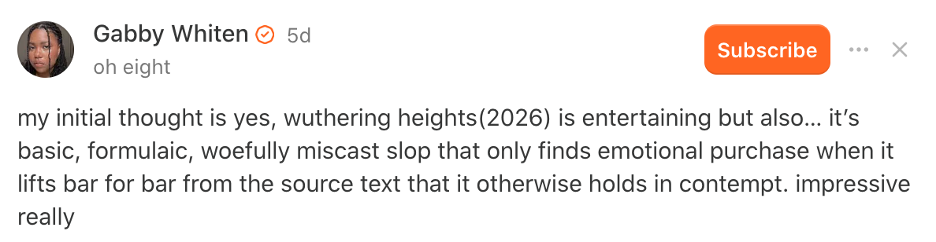
The “it’s not that deep crowd” only further justify this mentality. Those that claim that the racism in Wuthering Heights is a coincidence or urge us not to read too deeply into what is meant to be “just a steamy romance movie” refuse to engage with critical thinking for the sake of enjoying their slop in peace. Denial, denial, denial. Mindless consumption. White supremacy. Anti-intellectualism. I’m just a girl. The toxic cocktail that has made our society into what it is today.
We are in a media literacy crisis. Anti-intellectualism is a tool of the right to suppress critical thinking, so we can’t push back against harmful narratives, racist propaganda and revisionist history. The fact that we are being told to ignore Fennell’s in-film politics, and even what is right in front of our eyes, should ring alarm bells.
Wuthering Heights is not a right-wing dog whistle, but it is a litmus test for how much we are willing to let slide. Netflix has recently revealed it will be making a modernised adaptation of The Picture of Dorian Gray called The Grays, in which Basil and Dorian will be rewritten as siblings, erasing the text’s queer themes. This does not feel like a coincidence.
When we enter fascist times, what we see is a push by those in power to reimagine history as being without the undesirable groups they seek to eradicate. We’re seeing this happen in real time, and we can’t let it slide.