


Every summer, there’s a quiet ritual that plays out in changerooms across Australia.
A woman steps under unforgiving lights. She tugs, rearranges, breathes in, breathes out. She twists to look at the back, the side, the neckline. She pulls a tag that insists the size should fit, though nothing about the fit feels convincing. Within minutes, she has decided — again — that her body is the issue.
It’s a strangely universal experience: otherwise confident, capable women reduced to reading their bodies as problems to solve. Too soft, too long, too unevenly proportioned. Sitting somewhere “between sizes,” as if that’s a personal failing.
But here’s the truth: women aren’t hard to fit. Swimwear is still designed for a reality that hasn’t existed in decades.
The reality is far simpler, and far more frustrating: we’re not failing to fit the system — the system is failing to fit us.
Yet most women don’t know that the sizing system they’re being measured against is nearly a century old, built from male military data and a fantasy template of womanhood that has never reflected real bodies. Instead, they walk out believing the problem is theirs.
The size chart was never built for women
Modern sizing wasn’t created for women’s comfort or accuracy. It was standardised in the 1940s using men’s measurements, then adapted from surveys capturing only a narrow group of women. That rigid framework still defines swimwear today.
This outdated system assumes bodies don’t fluctuate. But women naturally shift up to 3 kilograms in a week due to hormones and fluid changes. Meanwhile, most swimwear only allows for 1–2 centimetres of variation — a design mismatch baked in from the start.
And yet it’s women who are told to shrink, squeeze, or “fix” themselves.
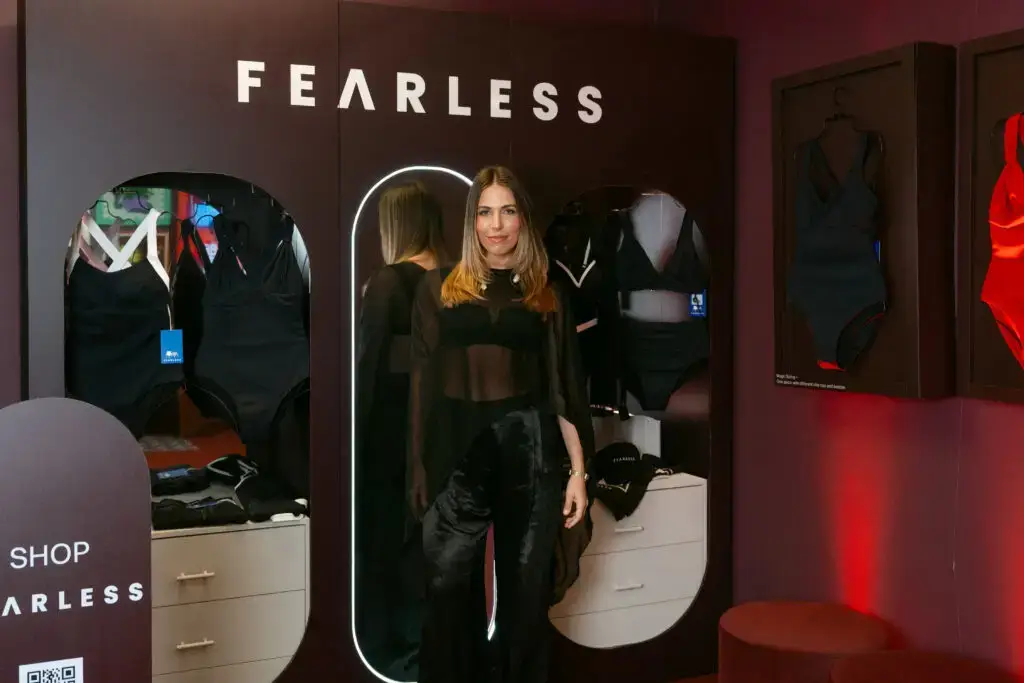
Most swimwear is still designed for one “ideal” body
Inside the industry, the standard process is unchanged: design a swimsuit on a size-8 fit model with perfectly balanced proportions, then “grade” up or down. A size 16? Just a stretched 8. A size 6? A scaled-down one. Not re-engineered. Not redesigned. Just resized.
When I began developing my own swimwear line, Fearless, I tested “one size fits most” suits on my size-12 postpartum body. Some went sheer. Others dug into my shoulders or gaped at the bust. I felt humiliated — until I learned something freeing: this wasn’t a personal failure. It was a design failure.
And the data backs that up. In early research, we measured 150 Australian women. Only two matched the traditional bust–waist–hip chart. Even professional fit models didn’t match it perfectly. How can women be expected to “fit” a system barely designed for them?
Women aren’t between sizes — the industry is between realities
When we started building Fearless Swimwear, we flipped the process: we designed on an Australian size 12, not a size 8 mannequin, and fit-tested our samples on more than 150 everyday women.
Women drove from Canberra, Newcastle, the Blue Mountains, Wollongong — mums, nurses, teachers, size 10s, size 18s, long torsos, big busts, soft bellies. The exact bodies the industry usually ignores.
We didn’t just test on them. We co-created with them. Over 10,000 women voted on everything from bum coverage to strap thickness and neckline shapes.
Their experiences revealed what the industry overlooks. Almost half (49%) of women wear different sizes on top and bottom. Meanwhile, 99% prefer wearing one-pieces, yet one-pieces assume symmetrical bodies.
This mismatch is the engine of that familiar changeroom spiral — the one that convinces women their bodies are the flaw, when it’s the system that’s broken.
Designing for movement, softness and fluctuation — not rigidity
All of this data led to something new. Fearless’ “Magic Sizing” — the first one-piece that lets women choose different sizes for their bust and hips. A size 12 top and size 14 bottom? Or vice versa. Magic Sizing works like mix-and-match bikinis, but for one-pieces.
For nearly half of women, that’s reality — and now the swimsuit reflects it. On launch, 15,000 women joined the waitlist, and 83% of stock sold out on pre-order day.
We also introduced long-torso options, because nearly one in five women told us they needed them. And we changed our entire fabric plan months before launch — abandoning shiny “premium” materials when they made women more self-conscious and choosing matte, recycled fabrics that supported without spotlighting.
This wasn’t simply an aesthetic decision — it was a design correction long overdue.
If the system is broken, why are women taught to fix themselves?
Despite everything we know — the bodily fluctuations, the diverse proportions, the clear demand for flexible fit — women have been conditioned to blame themselves.
But the problem isn’t us. It’s the infrastructure we’ve been forced to squeeze into.
Swimwear hasn’t evolved as quickly as women’s lives and bodies have. Bodies that fluctuate, age, stretch, strengthen, soften, feed babies, and carry us through messy, beautiful, real life deserve designs that move with them.
So the real question isn’t why women can’t fit into swimwear. It’s why swimwear hasn’t caught up. And until it does, let’s be clear: Women aren’t between sizes. Swimwear is between realities.
Lyndi Cohen is a dietitian, aka @nude_nutritionist, and now co-founder of Fearless Swimwear. Learn more: fearlessswimwear.com, or follow @fearless.swimwear