


Like all career-focused women in their mid-twenties, I spend a lot of time daydreaming about disconnecting from the growing demands of my adult life with an extravagant overseas adventure. A trip where I’d meet the version of myself I might be if I wasn’t worried about rent or work deadlines. I had no travel on the cards for this year and assumed I’d be doomed to live vicariously through everyone else’s Instagram posts. Never could I have imagined that I’d be going to Nepal for a week-long Women’s Expedition with Intrepid Travel, alongside some of the most accomplished players in Australia’s national women’s football league – North Melbourne FC’s Jasmine Garner and Ash Riddell, Carlton FC’s Darcy Vescio, and Collingwood FC’s Ruby Schleicher.
Nepal hasn’t ever been on my bucket list, but once the opportunity arose, I knew enough about the country’s major drawcards to assume that extensive physical activity would be on the itinerary. The South Asian country is home to eight of the world’s 14 highest peaks (those surpassing 8,000 metres in elevation), and famously includes the world’s highest: Mount Everest. There’s a reason many have struggled to picture me in trekking gear atop a mountain, and that’s because in reality, you’d have better odds finding me in the waiting room of a physio’s office getting treated for “tech neck”.
I’m far from being a professional athlete – I thrive in conditions that allow me to lie horizontal, book in hand and cat in lap. Yet looking at the jam-packed itinerary custom-built by Intrepid – featuring a whirlwind three-day trek along the Annapurna Region sandwiched by rich cultural experiences – I knew unequivocally that this was a trip worth being brave for.
I did some initial research, discovering that it wasn’t until the 1970s that Nepal first opened its borders to tourists – following more than a century of isolation under the autocratic Rana regime. Records indicate that the first people confirmed to have reached the summit of Mount Everest were New Zealand’s Sir Edmund Hillary and the Nepali-Indian Sherpa mountaineer Tenzing Norgay in 1953 as part of a British expedition. But it would take 40 more years for a Nepali woman, Pasang Lhamu Sherpa, to stand at the top of Mount Everest for the very first time in 1993.
Pasang, who was born into a local mountaineering family in the high-altitude rural town of Lukla – known to trekkers as the ‘Gateway to Everest‘ – refused her family’s plans for an arranged marriage, and escaped to Kathmandu with her chosen partner, trailblazer and fellow climber Lhakpa Sonam Sherpa. Pasang tried to reach the top of Everest three times, with little support from her community. In 1993, against all odds, Pasang made her last and only successful journey up Mount Everest. Tragically, she died on the descent due to severe weather conditions.
Since Pasang’s incredible milestone, Nepal now has many accomplished female climbers, guides and adventure leaders who are breaking barriers in the trekking field. Today, 53-year-old Nepalese mountaineer and mother of three, Lhakpa Sherpa, holds the record for climbing Mount Everest 11 times, the most of any woman in the world. The achievements of Pasang, Lhakpa, and countless other local women have well and truly proven that women are capable of meeting the physical demands of the world’s tallest and most challenging mountains – even while gender stereotypes persist in Nepal.
Arriving in Nepal
Upon arriving, I was introduced to our local leader, Intrepid Nepal’s Keshu Sherpa, and the eight soon-to-be friends who would also be experiencing Nepal alongside me with fresh eyes. As we met in the hotel lobby in Kathmandu, each accepting a glass of warm tea from the staff, I couldn’t help but compare its comforting temperature to the cold and unpredictable conditions that awaited us in the mountains in just a matter of days.
Over the next two days, our crew took a tour of Bhaktapur (where we learned about the Kumari tradition, visited Pottery Square, and tried Juju Dhau), tried our hand at making an authentic Dal Bhat (Nepal’s staple dish) under the guidance of Evana at Sungabha Nepal (which provides employment and educational opportunities for differently-abled women), and marvelled at UNESCO World heritage site Boudhanath Stupa. We also visited a Buddhist nunnery and heard from 50-year-old Head Master, Jangchup Gyalmo, about how the women there practise Buddhist philosophy outside of the more patriarchal traditions.
An uphill battle made possible by Nepal’s local heroes
Farewelling Kathmandu and bracing ourselves for a drastic change of pace, we then flew to Pokhara, where we’d start our journey in the mountains. There, at the foot of the seemingly never-ending steps that loomed before us, Keshu introduced us to her “sisters” – assistant guide Ritu Tamang and nine all-star female porters. At the time, the sisters, who presented as reserved and strikingly young, were just strangers leading starkly different lives from mine. But as I began to climb the stairs, I witnessed firsthand the strength, resilience, and joy of the young women who found their life calling in the quiet but challenging terrain of the mountains.
Tour Leader Keshu Sherpa became a licensed trekking guide after receiving her Bachelor’s in Travel and Tourism Management at the Nepal Academy of Travel and Hospitality Management. Her studies, she said, helped her realise the powerful impact that tourism can have on a country’s economy and livelihood — becoming a trip leader was her way of contributing to Nepal. But perhaps what’s become clearer over time is the impact this career path has had on Keshu’s personal life.
According to recent data, women account for only one-fourth of the total paid employment in Nepal, even though their overall labour force participation is now close to matching that of men. “Obviously, it’s given me financial independence,” says Keshu. “But working as a leader with different people in different circumstances has also built my leadership skills and improved my decision-making power.”
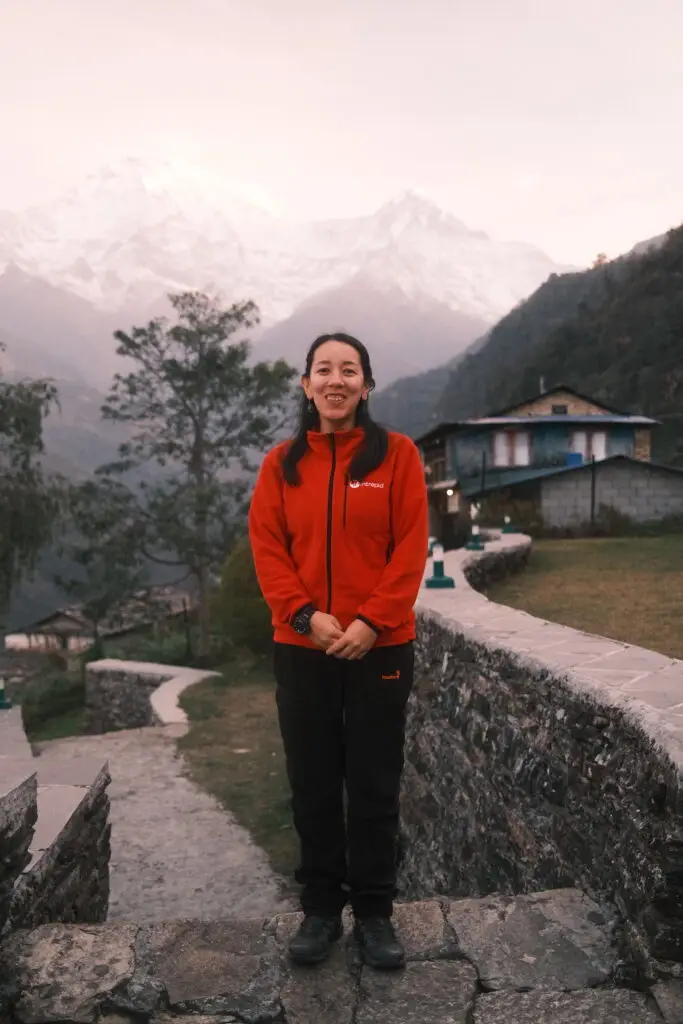
That very first day was not just the most difficult of our three-day journey, but one of the hardest of my life. Our large group relentlessly climbed for hours, gaining nearly 300 metres in elevation to reach Australian Base Camp. But it became apparent within the first 20 minutes that I wasn’t going to be able to keep up the pace set by the superstar athletes at the start of the pack. I was humbled immediately, taking constant rest breaks and fighting off tears as intrusive and unkind thoughts set in and reality dawned. “You’re embarrassing yourself, you won’t make it, you’re holding everyone up, this is humiliating,” were just some of the sentiments that attacked my brain, and even spilled out of my mouth. I felt like a fool complaining to Keshu and the other sisters who stayed back with me in the hot afternoon sun, while carrying our large bags on their shoulders. This was likely a regular good day for them.
“Sip, sip,” Keshu would tell me whenever I lost my breath (a phrase the infectiously cheery Ritu would later repeat when the two women swapped places on the trail). She’d reach for the water bottle at the side of my backpack and place the cool metal in my hands, forcing me to take a break. Every time I whined about not moving fast enough, Keshu would urge me to go slower, focus on my breathing, and take in the scenery. She seemed more disappointed by my constant apologising than my weak lungs and poor resolve. The sisters who stayed back acted like my need to pause every few minutes was routine practice, never mind that the AFLW players were so far ahead they weren’t visible on the trail.
Keshu calls her sisters “the heart and soul” of Intrepid’s Women’s Expeditions, which is fitting considering how much they strive to take after her. “[Keshu is] very bold and confident and brings all of us together with her support and guidance,” 21-year-old sister Binita told me. Without her support or the kindness of her sisters, I fear I would have been helicoptered out of the mountains and sent back home. It was their conversations and words of affirmation that got me from Kande to Australian Base Camp, allowing me to wake up the next morning with newfound pride and an unforgettable view of the sun rising over the Annapurna.
Their belief in me got me through the two (fortunately less challenging) days of trekking that followed. The sisters cheered me on when I managed to join the athletes at the front of the line on our descent, sang us their national hiking anthem as they crossed a shaky suspended bridge with ease, and shared their stories with us when we reached new teahouses at night. I learned through these conversations that the support we all felt from the sisters worked both ways. Many of them credit the guests they meet on these Women’s Expeditions with helping instil new confidence in their unlimited potential as young women in Nepal.
“[The guests we meet] have shown me that marriage isn’t the only thing women are supposed to do,” said Binita. “Without men, I can do many things,” she proudly declared. Ritu, echoing that sentiment in a later conversation, laughed as she recalled a time when a guest asked about her life plan. “I told her I didn’t know, but I guess I would get married at 24,” the single 25-year-old said. “Yes, marriage is good if you are ready, but if you pick the wrong husband and you aren’t independent, it’s very hard to speak out about it.”
Many women, Ritu shared, can’t find paid employment because they never received education or learned a skill. For one sister, 23-year-old Manisha, the job has helped her pay for university, and for another, 25-year-old Poonam, she no longer needs her husband’s permission to buy small things for her child. Ritu noted that Intrepid Nepal is an outlier in that way, providing secure employment for women, regardless of their education level or marital status. “Then we also get to meet new people who let us know that the world is very big,” said Ritu.
Breaking barriers in male-dominated industries
North Melbourne captain Jasmine Garner said hearing the sisters’ stories helped her see the similarities between their experiences as young women “going against the grain” as porters in Nepal and hers as one of the AFLW’s earliest trailblazers. Jasmine played in the inaugural AFLW match in 2017 alongside Ruby and Darcy and kicked the very first goal in AFLW history. Together, they made history before a massive over-capacity crowd of around 24,500 fans, 120 years after the inaugural men’s season kicked off in 1897.
In 2019, 53,034 people attended the AFLW Grand Final, the league’s highest attendance for an AFLW match, and this August, they commenced their 11th season. The AFLW is thriving, but players continue to face hurdles like wage disparities, unpaid overtime, and limited access to elite facilities, as well as ongoing prejudice from AFL fans who believe the sport is only a “men’s game”. It’s this shared rebellion against tradition and gendered expectations that Jasmine believes helped the sisters and players “connect so well”.
“You know [the sisters] kept saying that they really looked up to us and that we inspired them, but it was the other way around as well,” said Jasmine. Some of the players even got teary hearing from them. “It actually makes me a bit emotional hearing you guys talk about creating your own independence…we come from a very privileged place, and we’re very supported,” Collingwood captain Ruby Schleicher told the sisters. AFLW players still face challenges from those who doubt their abilities, said Ruby, but the sisters “face a challenge from [their] entire community”.
“It’s cool that we have our football uniforms that we pull on and you’ve got your Intrepid gear,” said Carlton’s Darcy Vescio, one of the first marquee players in the AFLW. “When you’re wearing [those uniforms] together, you know that you’re all moving together and that you’ve got your sisters around you, just like we do,” they continued. “I think that’s really amazing.”
The moments I’ll never forget
As my group sat in a circle with Keshu and her sisters on the final night of our trek (after a fierce game of AFL), sharing what the experience had meant to us, tears finally slipped down my face. It became clear to me that millions of small and seemingly insignificant moments had to have happened for each of us, without error, for this moment to have happened. We didn’t need years or even weeks to bond or find commonality in our seemingly different lived experiences. The spectacularly beautiful mountains had brought us together but were merely a backdrop to the real story of sisterhood and shared courage that had unfolded over three short but life-changing days.
A few days after saying goodbye to the sisters, my group made our way to Kathmandu Airport to begin our journey home. During the flight, I thought about Pasang Lhamu Sherpa and how lucky I was to witness the impact of her historic feat living on in the bravery and spirit of the local Nepalese women, who continue to redefine the role of women in the male-dominated mountaineering community.
When we think of adventurers, we often think of serious men abandoning their responsibilities to risk their lives in the wild, but now I know that some of the bravest and most inspiring mountaineers are young women who laugh and sing and dream of a life without limits.
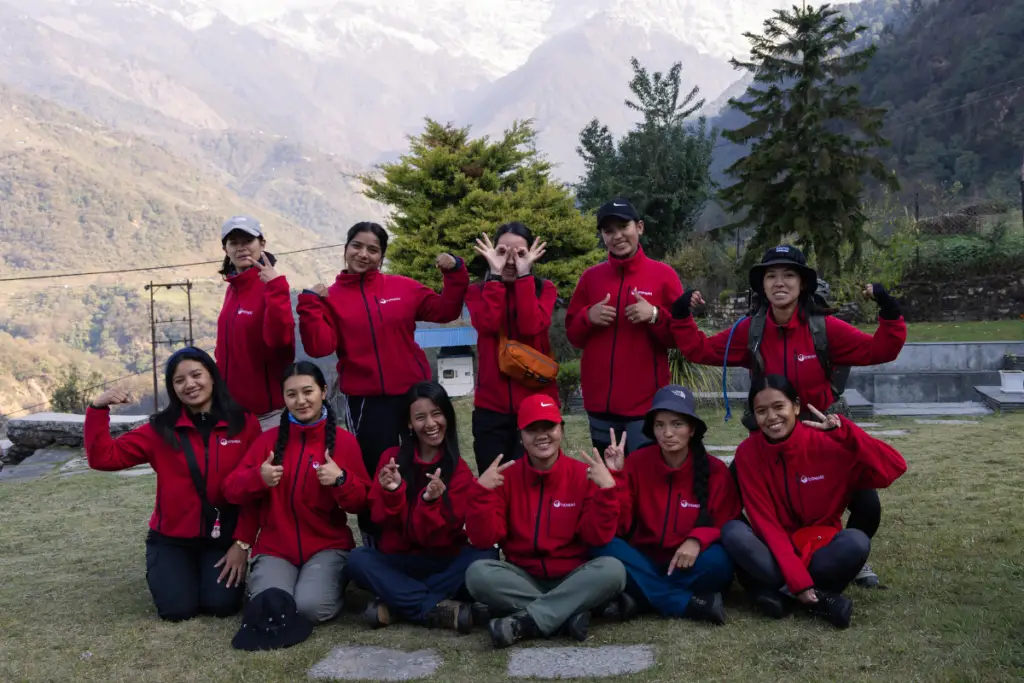
Missing Perspectives was a guest of Intrepid Travel for a condensed 7-day Nepal Women’s Expedition in March alongside four AFLW players known for their impact on and off the field. Intrepid offers a 13-day Women’s Expedition in Nepal, shattering the barriers of traditional tourism with female-led immersive cultural experiences combined with a five-day trek led entirely by a female team of mountain guides and porters.
Photos supplied by Marianna Galanopoulos, 2026