

Hi Vivian. Please introduce yourself.
Hello! I’m Vivian Pham, a Vietnamese-Australian writer and creative writing teacher from southwestern Sydney.
You started writing The Coconut Children when you were just sixteen and became a debut novelist at 19. When you think back to being a schoolgirl taking part in a writing program at the Story Factory in Sydney, did you ever imagine your short story would become a 90,000-word book that sparked a bidding war?
I grew up looking up to my older sister, Kim Pham, who is an incredible screenwriter, playwright and poet. We always had big dreams and big self-belief. The creative path isn’t clear-cut, but imagining your story reaching readers and audiences far beyond the present has been an essential part of my fiction-making process.
I imagine it must have felt surreal. It’s a rare success story, and as a young woman of colour suddenly navigating a decades-old, elite institution like the publishing industry, I wonder how you handled the overwhelm. Did you have connections in the literary community to lean on for guidance, or was much of it learning on the go?
Surreal, yes! When I was first starting out, I remember feeling quite alone and clueless in navigating the publishing industry and its various institutions – then you come to realise that all these behemoths are only made up of other people. Slowly, you begin to build community, and that has been the joy of my career. When you have a goal that is anything larger than self-advancement, other people are necessary.
The Coconut Children is a coming-of-age novel written for “anyone who feels like they were robbed of their childhood and wants to see their childhood in another way, in a more magical way”. In it, you argue that “growing up can feel like a death sentence”. How do you think your reflections on adolescence would have changed if you were approaching the text now as a 26-year-old?
Considering this country’s track record of child imprisonment and the ongoing genocide in Palestine, which disproportionately affects children, I think it has only become more important to consider childhood in the context of human rights. To consider who in the world right at this moment is being denied their childhood, their innocence, and their ability to imagine their future. As a 26-year-old, I’m still interested in what is ‘magical’ about the world, and to centre, through fiction, who is still only experiencing it for the first time.
Your book is set in 1998, when anti-migrant sentiment in Australia was incredibly high. Theatregoers will watch your story come to life on stage 28 years later, and yet it feels like we’ve politically returned to some of the reductive narratives used to demonise migrants back then. In 2026, what’s changed and what feels the same?
My hope is that in sharing this story, these reductive narratives used to promote fear of migrants can be laid bare as the utterly flimsy, meaningless, and circular narrative structures that they are. They manufacture conflict that doesn’t exist to run from any attempt at resolution, which is antithetical to good storytelling. Stories are not about conflict but conflict resolution.
What can fans of the book expect from Belvoir St’s stage show? What were the biggest challenges and greatest opportunities in reimagining the story for a live audience? Could a screen adaptation be next?
Fans can expect historical narratives that snake around living, breathing, in-the-flesh characters, and the butterflies and slow-burn of two teenagers becoming friends again. It was a challenge to condense the novel into a dramatic form that is based on verbal acts, since our protagonist, Sonny Vuong, has such a rich interior life and often cannot say what she means. Knowing that audiences would be forced to sit through every line I wrote and therefore striving for a reasonable time limit was a great opportunity. I enjoyed killing my darlings.
A screen adaptation directed by Kim Pham will be next. As Octavia E. Butler says, ‘So be it! See to it!’
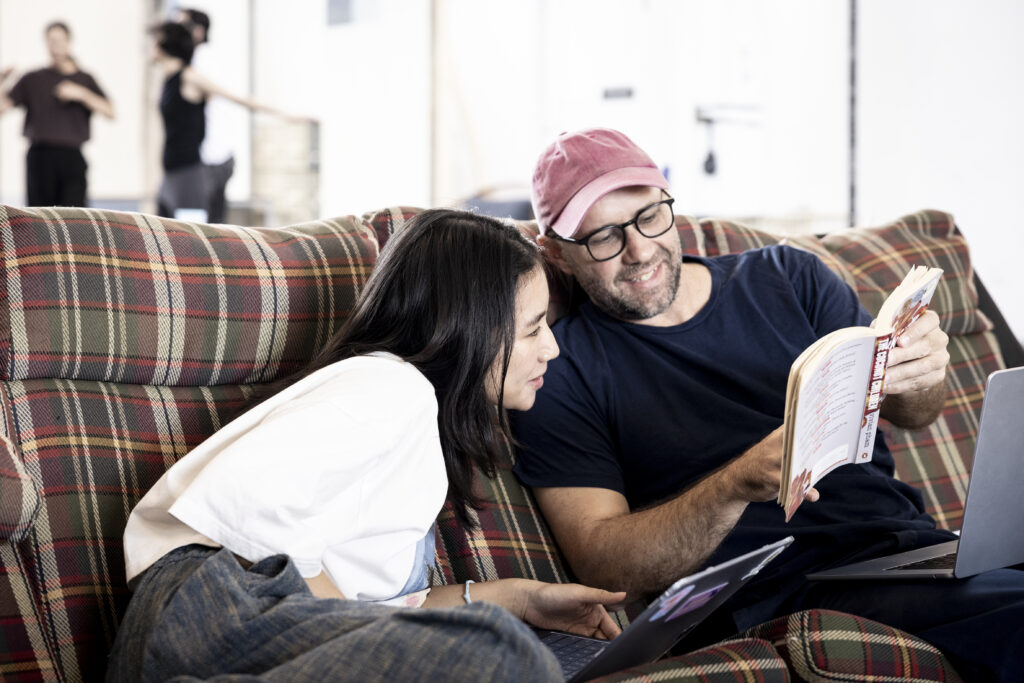
Your female lead, Sonny (great name, btw), is a cautious teenager whose imagination is fuelled by romance novels and unrequited crushes. You and I are the same age, and while I don’t want to make assumptions about your teen years, I spent much of mine the same way Sonny does. Back then in the mid-to-late 2010s, teenagers tended to look down on their peers who spent their time between the covers of a book, and I remember it being a really embarrassing time to be a romance reader. Fortunately, a lot of that sentiment has changed now. It’s cool to be a reader. Romance is one of the best-selling fiction genres, and smutty or cheesy love stories are now disguised by cutesy illustrated covers that are acceptable to read in the schoolyard or on the bus. What do you think is driving that cultural shift, and are there any contemporary romance novels you think Sonny would have LOVED to read back then?
Romance is such an important genre to me because there are so many interesting perspectives to read a love story from, while still appreciating the cheese, smut, and sentimentality. Romance places us readers in close proximity with our highest ideals. It can, if we allow it, make us question if what we idealise in literature is what we want in life. That requires an honesty, or an intimacy, that other genres don’t.
Next time you pick up a romance novel, consider this bell hooks quote: “part of what a culture of domination has done is raise that romantic relationship up as the single most important bond, when of course the single most important bond is that of community.” Do you agree? Why, or why not? To what extent are you participating in what ‘a culture of domination’ has decreed? Does the fictional man in that book need that six-pack for his character development – what’s more, and is that physique even reasonable in his work as a CEO? (Lol.)
You’ve spoken about writing weekly fanfiction instalments on Wattpad as a teen. 1) What fandoms did you write for? 2) What do you remember from that time? And 3) Do you think your experience as a young person self-publishing original work to a digital audience on Wattpad helped prepare you for your career as a published writer?
The 2010s were an interesting time to be a teenager, and a fruitful one to discover you were a writer. That feeling I described earlier, of having big dreams and big self-belief, was really nurtured by the Internet in that era. One Direction was the fandom I pledged my allegiance to, but my Wattpad fiction traversed a few realms. I remember losing my password and logging in months, perhaps years later, finding comments from readers begging me to upload another chapter immediately. Knowing that there were voraciously passionate readers and writers online lent a certain levity to the more traditional publishing journey I was to have later on. (Wow, I’m learning a lot about this journey, thanks to these wonderful questions!)
Beyond becoming published in your teens, many of your achievements have been attached to your age – from winning the SMH Best Young Australian Novelist Award to representing your peers on a global stage at the International Congress of Youth Voices. How do you feel about your youth? Is it something you wish to hold on to or are eager to shed?
I feel protective of the irrepressible hope, rage, curiosity and cynicism that motivated me to read and write as a young person. I also feel, intensely, the privilege of being able to grow older. I think – I hope! – I am learning to be more patient.
You share personal reminders and reflections on writing to your Instagram account. In one post, you wrote, “It is the responsibility of the writer to dawdle. The inspiration and persistence that goes into something as colossal as a novel, play or poem doesn’t often strike when someone is doing something urgent and useful”. As a professional dilly-dallyer, reading your words at a time when self-optimisation is all the rage and allowing yourself to be an imperfect beginner is a lost art, your words really resonated, but it also surprised me to see them come from someone with achievements and experiences beyond their years. I can’t imagine you’ve had any time to dawdle. Tell me why you reject “urgency”; have you always felt this way?
Urgency is a part of the incentivising logic (labour to produce product for profit) that operates in the background of all human endeavours, perhaps especially creative ones, as creatives are continually made to justify our contributions to society. It’s taken me years to learn to dawdle, to learn that restlessness and urgency were not serving me.
When you think of the Australian classics that make up much of our educational curriculum, old books written by white men tend to come to mind. What local stories do you consider classics?
At What Cost by Nathan Maynard. Discipline by Randa Abdel Fattah. Compassion by Julie Janson.
What’s next for you?
Another novel! This one will be a romantic comedy…
Vivian’s hit novel, The Coconut Children, has been turned into a stage show and opens at Belvoir St Theatre on 21 November. Tickets are selling fast, get yours here.