

Data in the Australian Bureau of Statistics (ABS) 2022 National Health Survey (NHS) indicated 61% of females were living with at least one long-term health condition in 2022. Yet, women’s health is a space that doesn’t receive nearly as much attention as it deserves. We’re talking about a lack of awareness about particular conditions to the underfunding of support services, and women feeling comfortable to talk about their bodies and minds without feeling judged or shamed.
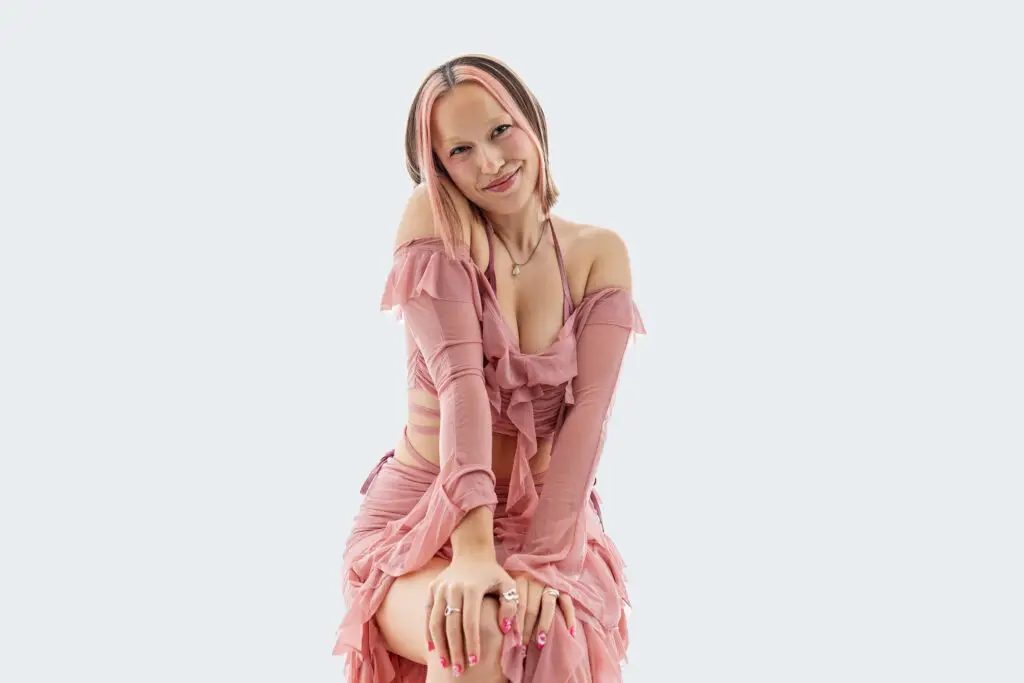
Destigmatising women’s health issues and making information accessible, is a huge priority for Dr Naomi Koh Belic. She’s the face of Bimbo Biology, a social media health series that empowers people with knowledge about their own bodies. With episodes zooming in on topics like ‘big clit energy’ and ‘hot girls have IBS and anxiety’, she’s passionate about making science accessible. She’s proudly biracial and bisexual, and a university graduate with a PhD in stem cell biology. She’s definitely someone who’s big on amplifying voices of minority communities, and that’s something we consistently advocate through MP aswell.
On that note, Alicia sits down with Dr Naomi Koh Belic to hear lots more on her career, representation and normalising important health conversations. Enjoy!
Note: This interview has been edited for length and clarity.
Bimbo Biology Body Breakdown covers topics that are often stigmatised or overlooked in mainstream health conversations. Why is it important to you to spotlight these stories?
Academia and media are still predominantly run by and for cis, straight, white, privileged men. I tell stories for people that are often left out of mainstream health conversations, because everyone deserves access to educational content. Bimbo Biology is hyperfeminine and doused in glitter – it’s a space for the girls, gays and non-binary babes to be empowered with knowledge about their own bodies.
In one of your Instagram videos, you spoke about being called a ‘Kardashian’ by a senior male academic when you landed roles on the ABC and Discovery Channel. You were also labelled by some as “too young and girly to be an expert”. At the time, how did this make you feel and how did you navigate it?
During my PhD in stem cell biology, I landed a show on Discovery Channel then another on ABC. It should’ve been my big break, but I was told I was too young and girly to be an expert, asked what it felt like to be a diversity hire, and told to keep my eyes open (for the record my eyes were open – I’m just Asian). I honestly internalised those comments, and it was only years later that I found the confidence to pursue science communication as a career. This time I wanted to do it on my own terms with my own diverse team. That’s why I started Bimbo Biology.
What do you think academic and media spaces spaces still fundamentally misunderstand about accessibility and diverse storytelling? Are we seeing an improvement in recent years?
I have experienced racism, misogyny and homophobia in both media and academia. But I’ve also found an incredible community of diverse folks in those spaces, many of whom have become my closest friends. In some ways things have improved – I’ve encountered many well-intentioned people trying to advocate for more diversity. But overwhelmingly, the people in positions of power are old and white, and it’s hard to convince myself there has been genuine improvement when decision makers still don’t reflect the diversity of the rest of the industry. It is one thing to employ someone from an underrepresented community; it’s another to uplift and allow them to create meaningful change.
Now that you’ve flipped the script with Bimbo Biology, what does reclaiming and embracing the word “bimbo” mean to you?
I was born and raised on the Gold Coast – wearing tiny pink bikinis and being hot is simply my culture. I want to show people that beauty and brains aren’t mutually exclusive, that you can be covered in glitter and rhinestones while still being the smartest person in the room. At my big age I’m too exhausted to shrink myself to fit someone’s narrow view of what they expect me to be. I’m the proud daughter of Singaporean and Croatian immigrants, a first-generation university graduate, flaming homosexual, and I look fucking great in pink.
You’ve also spoken about being asked by people “what it felt like to be a diversity hire” when you began your TV roles. When you hear something like this, how do you interpret it as a biracial and bisexual woman? As a woman of colour, I often feel that the stakes are higher for WOC and we must prove ourselves more in order to not only succeed, but to then justify our success. What are your thoughts around this?
When someone you respect tells you that you didn’t earn your position… you tend to believe them. It’s only with hindsight that I can recognise I am painfully more qualified, intelligent and charismatic than the man who said those things to me. But it has taken years of therapy, reassurance from friends, and deep internal reflection to convince myself that I deserve to take up space. I think that’s why I do it so loudly now, not only to reassure myself that I do in fact belong, but to encourage other people to do the same.
When it comes to your audiences, what are some of the most common health or science myths/misconceptions that you hear, or questions that you’re asked?
I am so proud of the community we built through Bimbo Biology and the breadth of questions my fellow bimbos asked. What tied most of those questions together was that they were often from underrepresented communities. An example is the episode I made about how lesbian mums can both make milk to feed their bub, which had plenty of questions from queer and trans people. Examples of questions I made video responses to include whether trans women can lactate (they can!), lesbian mums asking for tips on co-lactation or trans people wondering how top surgery or breast implants can impact lactation. I am beyond grateful for the thoughtful questions people asked, and it is an absolute privilege to be able to do research to answer them.
Was there a particular episode that surprised you while creating it?
As a hot girl with both IBS and anxiety, I had always thought of them separate things, but I was shook to my core when I realised IBS and anxiety are intertwined. You see, we often think of IBS exclusively as a gut issue, but it’s actually a disorder of altered gut-brain interactions!! Hot girls have anxiety and IBS is one of my favourite episodes of the series, but honestly I’ll take any opportunity to yap about my sloppy plops.
You’ve built an incredibly engaged audience online. Why do you think people are responding so strongly to this content? What kinds of responses or messages from viewers have stayed with you the most?
I think Bimbo Biology resonates with people because it tells the stories we don’t often hear. I made an episode about diabetes that specifically highlighted lessons from Aboriginal women, and one of the video responses I made was about fatphobia in type 2 diabetes discourse. Then nutrition expert Dr Emma Beckett brought her expertise to the conversation. The direct messages I got during this week have really stayed with me. There were so many people who generously shared their experiences with fatphobia and type 2 diabetes. They detailed the ways that the medical system has failed them. I hope my series can remind people that they deserve empathetic medical support, while holding medical practitioners accountable.
What advice would you give to young people, especially diverse women and queer people, who feel alienated from academia or STEM spaces?
Find community. Really go out of your way to build community, because you deserve support. I found queer Asian community through Worship Queer Collective events and honestly made lifelong friends through social media. Therapy has also been pivotal in helping me navigate academia and media. I recognise how expensive therapy is – but there are some cheaper alternatives like the psychologists in training that I saw during university. I now have a wonderful Southeast Asian clinical psychologist who makes me feel seen and supported. I sincerely hope that therapy becomes more accessible because it can empower you to shift the trajectory of your own life.
Finally, what’s next for you and Bimbo Biology?
I can’t spill what the next season of Bimbo Biology is about yet – but when I can, I’ll be screaming about it on my socials. But I can announce that I am ABC’s inaugural Science Journalism Fellow! This will involve me creating my own YouTbe health series that will launch later this year. In the meantime, you can watch Sextistics, which I had the honour of directing and producing alongside iconic mother and daughter duo, Dr Esmé Louise James and Dr Susan James.
Top photo – Pictured: Dr Naomi Belic, Source: Supplied/Teresa Tan