


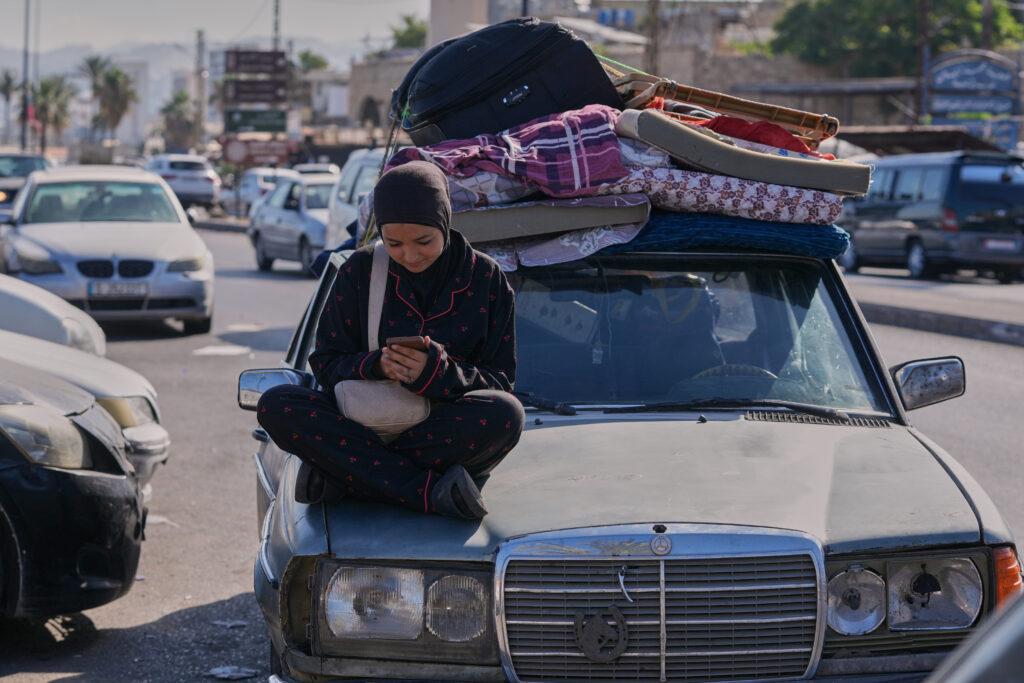
Two women sitting outside their tents on Beirut’s waterfront told me that the life awaiting them would be hellish, even in the best circumstances. Tomorrow seemed too far away. Their concern was simpler: finding lunch for their families.
Life in a tent, still unfamiliar to most Lebanese women, resembled what we had long heard about Palestinian and Syrian refugee women, and displaced women across the Middle East. The Arabic word is qahr قهر. It means more than oppression or domination. It is being trapped in a fate one did not choose and cannot change; depending on others for basic necessities; living with uncertainty, helplessness, and abandonment.
When these women, who had fled Lebanon’s south, heard of a ceasefire, they allowed themselves to hope. But there was no meaningful ceasefire in Lebanon. The war continued.
These two Lebanese women and myself, along with hundreds of thousands of others, now share the same ordeal since the war between Israel and Hezbollah resumed on 2 March 2026 – after two years of intermittent conflict. To walk along Beirut’s waterfront and see Lebanese families displaced in their own capital remains startling. Lebanon, especially Beirut, had long seemed like a refuge for the displaced of the Middle East. Until now, qahr was something we associated with others, not with our own memory.
A Country Displaced
Numbers cannot contain grief, but they show the scale of the crisis. The United Nations Population Fund (UNFPA) – which is the UN’s sexual and reproductive health agency – has been releasing such data throughout the crisis According to UNFPA’s Situation Report on the ‘Lebanon Crisis’ for 26 March to 1 April 2026, around 1.2 million people had been displaced in Lebanon, including 620,000 women and girls. Among them were 325,500 women of reproductive age, around 13,500 pregnant women, and about 1,500 women expected to give birth within 30 days.
These figures matter because women are not a footnote to the crisis. They are displaced, pregnant, caring, queueing, organising, and carrying the fear of others before their own can surface.
But displacement isn’t lived as a statistic. It is lived as the absence of a door that locks; as a woman rationing water because the toilet is shared and unsafe after dark; as changing clothes in a tent, breastfeeding near strangers, managing a period without enough pads or privacy, and answering a child who keeps asking when the family will go home.
UNFPA indicated in March 2026 that shelters in Lebanon were overcrowded and often lacked adequate sanitation, lighting, and privacy. The absence of gender-separated facilities increases “the risk of violence for women and girls and severely limits their mobility”, the organisation stated. In such conditions, privacy is protection.
Pregnancy Without Continuity
Maternal healthcare in Lebanon was already strained by economic collapse and a weakened public sector. War has made it worse. Pregnancy needs continuity: checkups, tests, medication, transport, trust, a safe place to deliver, and someone to call when something goes wrong. Displacement breaks that continuity. It scatters medical files, interrupts treatment, closes roads, drains money, and makes each appointment difficult.
In March 2026, Reuters reported on displaced mothers in Lebanon giving birth amid fear, overcrowding, and disrupted care, including women who lost access to the doctors who had followed their pregnancies. The report also cited the aforementioned UNFPA estimate of 13,500 displaced pregnant women and 1,500 expected births within the following month.
Childbirth is often treated as a single event. For women, the before, during, and after significantly matter. The after is often neglected: bleeding, fever, pain, hunger, exhaustion, and depression in a setting where everyone else is also afraid.
The Needs No One Wants to Name
Lara Assi is a British Lebanese grassroots humanitarian activist supporting displaced families. In an interview for this article, Assi described the healthcare crisis as one of interruption rather than total absence, citing examples such as: “A diabetic woman who left her insulin behind. A pregnant woman with no prenatal care and nowhere to deliver safely. Postpartum women bleeding with no follow-up. Chronic conditions are going dark because the money is gone. Mental health that no one is even counting”.
In Lebanon, trauma is often treated as normal. Women cook what is available, comfort children, search for medicine, call relatives, queue for aid, care for the elderly, and manage the needs of the family before their own.
This is the gendered labour of displacement. Women remember who needs blood pressure medication, which child has a fever, who hasn’t eaten, who needs underwear, who is too old to stand in line, who may be pregnant, and who has stopped speaking.
Assi’s field observations return to the same needs: menstrual pads, baby formula, diapers, postpartum and maternity supplies, underwear, blankets, transport, medicine, and direct cash. These are not secondary items. They are basic dignity. “Getting your period in a shelter or a tent with no pads and no privacy is every woman’s nightmare,” she observed.
The Aid Gap
The humanitarian response thus far hasn’t matched the scale of need. The Lebanon Response Plan 2026 released in February – and jointly led by the Government of Lebanon and the United Nations – estimated that 2.99 million people in Lebanon needed support, and that US$1.62 billion was being appealed for to assist 1.5 million people.
After the escalation of war, OCHA’s March to May 2026 Flash Appeal called for US$308.3 million to provide life saving assistance and protection to up to 1 million people. By June, Reuters reported that the UN was seeking US$639.9 million, after adding US$331.5 million for worsening needs. As of 31 May 2026, only US$185.9 million had been received.
Again, funding gaps mean less resources: no diapers, no transport to a clinic, no blankets for a sick elderly woman, no food parcel in time.
Women as Responders
Because aid has been insufficient, local initiatives have filled part of the gap. Women’s groups, municipalities, local organisations, and individuals have distributed food parcels, hygiene kits, blankets, medicine, menstrual pads, baby formula, diapers, maternity supplies, underwear, transport money, and direct cash support.
Women have been central to this response. They volunteer in shelters, sort donations, identify urgent cases, coordinate with drivers, contact pharmacies, support psychosocial care, and handle the administrative work that allows aid to move. This work isn’t only about compassion. It constitutes logistics, organisation, and survival.
Twenty Dollars’ Worth of Warmth
One episode from Assi’s relief work shows the scale of need. While distributing aid, she had to leave quickly as bombing intensified. As she was leaving, an elderly woman, the age of her grandmother, ran after her in tears, asking for blankets. The woman had a chronic illness, and the cold made it worse. What was visible was not only the ‘need’, but a sense of ‘shame’: not shame at needing help, but at the situation that forced her to chase a stranger down the street.
Assi returned to the car and gave her several blankets worth about $20. Less than a kilometre away, that amount might be spent casually on a burger.
This is the arithmetic of displacement. A woman’s warmth costs less than a casual meal. A taxi to a clinic cost less than an evening out. Pads, formula, insulin, antibiotics, underwear, and blankets are small items, but they are beyond families who have lost homes, income, savings, and certainty.
Against Abandonment
On Beirut’s waterfront, the women outside the tents weren’t asking to become symbols. They were asking for lunch, medicine, safety, privacy, and a day without humiliation. They were also caring, organising, enduring, and remembering.
To speak of qahr is to name the violence of being trapped, exposed, and dependent while the world debates your fate from a distance. But qahr is not the end of the story. Against it stand direct acts of support: a pad handed over discreetly, a ride to a clinic, a bag of diapers, a phone call answered late at night, $20 turned into warmth.