


For the past few weeks, stadiums across Australia have been filled with drums, flags and chants as the 2026 AFC Women’s Asian Cup unfolded.
I attended almost every match of the tournament, excited to cheer on the Matildas and the region’s best players. What I didn’t expect was how many small human moments would stay with me long after the final whistle.
Beyond the goals and results, the tournament reminded me of one of the most magical feelings about women’s sport: its ability to connect people and inspire resilience.
Here are some moments of the tournament that took me by surprise and have stayed with me since.
1. South Korean fans coming out to support North Korea
One of the most surprising scenes of the tournament came from fan chats ahead of the North Korea matches.
The majority of nations were supported by either diaspora members, or people with previous tourism or cultural connections to the country. However, due to the inability of most citizens to leave North Korea, it remained a very curious question as to who, if anyone, would fill that gap for the Korean side.
In a heartwarming display, it was South Korean fans that showed up for North Korea.
“They’re our brothers and sisters,” said one South Korean fan I spoke to. “We know there won’t be many people supporting them, but we want them to know that ‘we are there for them’.”This was a sentiment echoed by many Korean supporters. “How wonderful is it that we live in a country like Australia that is so multicultural, that I can support Australia, South Korea and North Korea?” said another South Korean fan, with the North Korean colours painted on her face.
Especially in times like these, it was truly special to see the incredible cross border support from countries that the world otherwise classes as rivals.
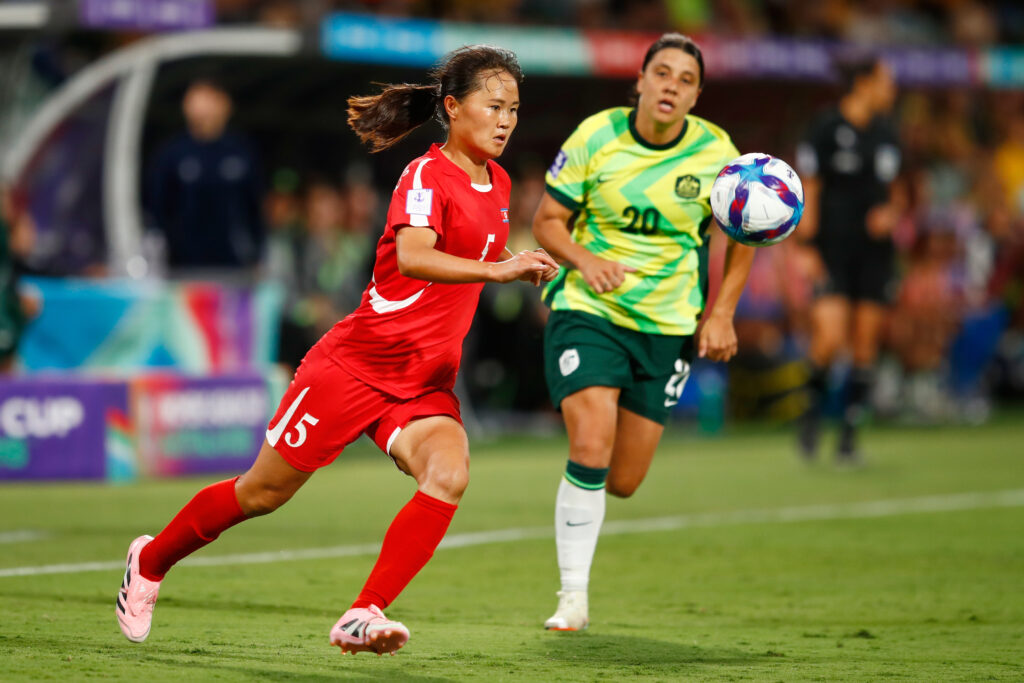
2. The (un)expected North Korean supporter base: Aussie school kids.
Not all of North Korea’s fans had such reflections driving them.
Perhaps unsurprisingly, Australian school kids formed the other large cohort of North Korean supporters on the ground.
“When else are you going to get to support North Korea?” said a schoolboy with excitement when I asked why he had chosen to support the nation. “It’s a once in a lifetime opportunity,” said another, waving the North Korean flag he had brought along.
While the intention was of jest, as the kids laughed and jeered, they were committed. Most of them had the North Korean flag painted on their faces and arms, and while a Women’s Asian Cup T-shirt, scarf & hat would set one back almost $100, some of the kids were decked out head to toe in merch for the North Korean team.
When it came to observing the action during the match the group proved to be very vocal supporters too. Every forward pass from North Korea was met with cheers and chants, I wonder if the North Korean players were surprised with the support.
3. The Matildas’ impact on the Iranian team
The Matildas’ incredible performance at the 2023 Women’s World Cup left a legacy in Australia that will be remembered forever. It was somewhat unbelievable to see the impact it had outside the continent.
In the pre-match press conference for Australia’s game against Iran, Iranian forward Sara Didar was asked about facing the Matildas. Until that moment, the atmosphere in the room had felt slightly tense, likely shaped by the difficult geopolitical context surrounding Iran.
But when Didar spoke about facing Australia, her face lit up. She smiled as she spoke about how much the Iranian team loves Sam Kerr and the Matildas, and how it was such an honour for them to play Australia.
Didar’s comments echoed those of many Asian players around the region, who have heralded Kerr in particular, as being an inspiration for them.
When I asked Sam Kerr about Didar’s comments, the Aussie captain couldn’t help but smile too. Confirming she had seen them, she shared that the team even exchanged jerseys after the game.
Kerr emphasised that the warm feeling was mutual, and that the Matildas held a lot of respect for the team, especially with everything they had going on outside of the game. Amidst incredibly difficult circumstances for the Iranian team, it is nice to know that their interactions with the Matildas gave them a moment of joy.
4. The Bangladeshi Uncle support
No supporters matched the energy of Bangladesh’s travelling fan base.
Hundreds of Bangladeshi supporters, the majority of them middle-aged fathers, gathered outside Western Sydney Stadium in Parramatta, wearing deep green shirts, beating drums and chanting loudly.
The messages I heard from them echoed the same themes.
“We don’t care if they lose,” said one of the fans, part of an entourage of 6 Bangladeshi uncles. “To even be here is amazing. We are so proud of our Bangladeshi girls.”
That pride never wavered as their country’s team struggled during the match. The Bangladeshi players kept putting their literal bodies on the line, jumping and running, trying to do everything they possibly could to stop the ball from going in. In the end, Bangladesh lost 5-0 to North Korea, but the chants never stopped. Every tackle and every clearance was met with cheers.
The resilient support stretched back home too. A Bangladeshi journalist covering the tournament told me the country’s goalkeeper Mile Akter comes from a family so poor, they do not own a device to watch her matches. Instead, her family gathers at local tea stalls to watch her matches on communal televisions.
Ultimately, seeing the belief the supporters held was a good reminder that for many players at this tournament, playing at this stage is already historic.
5. Uzbekistan made history. The fans cried. The players cried
It was the most incredible of scenes as Uzbekistan qualified for the knockout stages of the Women’s Asian Cup for the first time ever, an achievement that also puts a potential World Cup qualification within reach.
When the final whistle blew, some of the Uzbekistan players were so overwhelmed with emotion that they cried – leading to fans crying themselves as a response to the players’ emotional reactions. What a moment it meant for the team, for their country.
An Uzbekistan supporter, who is following the team around the country, told me that she was so nervous every single game. But seeing them make history, made it all worth it.
“They have inspired me to believe,” she said, highly confident that they will continue to make the country proud when they host the next Women’s Asian Cup in 2029.
6. Alanna Kennedy becoming the top goal scorer of the tournament.
This was so unexpected, that even Kennedy herself did not anticipate it. Matilda’s defensive player Alanna Kennedy currently sits top of the Women’s Asian Cup goal scoring charts, with 5 goals in 4 games.
The past few months have been difficult for the veteran defender. She lost her starting place at club level, was moved into unfamiliar midfield roles, and left fans furious after receiving an early red card in Australia’s much-anticipated match against England.
In spite of her years of service to the team, many had begun questioning her place in the Asian Cup squad.
But narratives in sport change quickly. Despite the noise, Kennedy shone brighter than ever, becoming the hero Australia needed, not once, not twice, but three times in four games.
“I’m so proud of her,” said Matildas player Katrina Gorry, when I asked her if she had realised that Kennedy was now the top scorer in the tournament.
“I think you know the last few years haven’t been easy for her, but to see her scoring absolute bangers,” she added “I’m grateful to be on the pitch with her”.
Kennedy’s journey this tournament is an inspiring example of how life goes up, life goes down, but that you should never stop believing in yourself.
While there was so much incredible football on display, what stayed with me most after spending weeks travelling across the country, was the spirit of the tournament; the belief, the resilience, the unwavering passion and the unlikely communities it brought together.
For me, the growth of women’s sport isn’t just about the game. It’s about the stories we now have the privilege to witness and share.