


I started my career as a student midwife. In the healthcare system, I repeatedly witnessed women being caught out without period products. It wasn’t a rare occurrence; it was a constant, underlying friction. The products simply were not where women needed them to be and that stayed with me.
Years later, I left healthcare and transitioned into brand marketing. There, I witnessed something equally absurd from the other side of the aisle: brands were spending staggering amounts every year on digital ads – $667 billion in 2024 for example – that women scroll past, skip and actively resent. So much money spent and almost zero trust built.
Then came a moment of simple clarity. Think about any high-traffic bathroom in the world. Toilet paper is free. Nobody questions it; it’s a basic amenity. So why aren’t period products treated the same way?
The Access Problem We Keep Ignoring
In 2025, research conducted by Ideally and commissioned by Afterpay revealed a startling statistic: 3 in 5 Australian women have used toilet paper, socks, or other makeshift substitutes for period products because they lacked access. Let’s be clear: this is not just a poverty problem. It is fundamentally an access problem. Products are not in the right places, for free, when women actually need them.
That realisation sparked ON THE HOUSE. I spent two years building and rebuilding the model. I rewrote financial projections more times than I can count, pitched to rooms full of investors, failed, failed again and ultimately raised $1.7 million in seed funding.
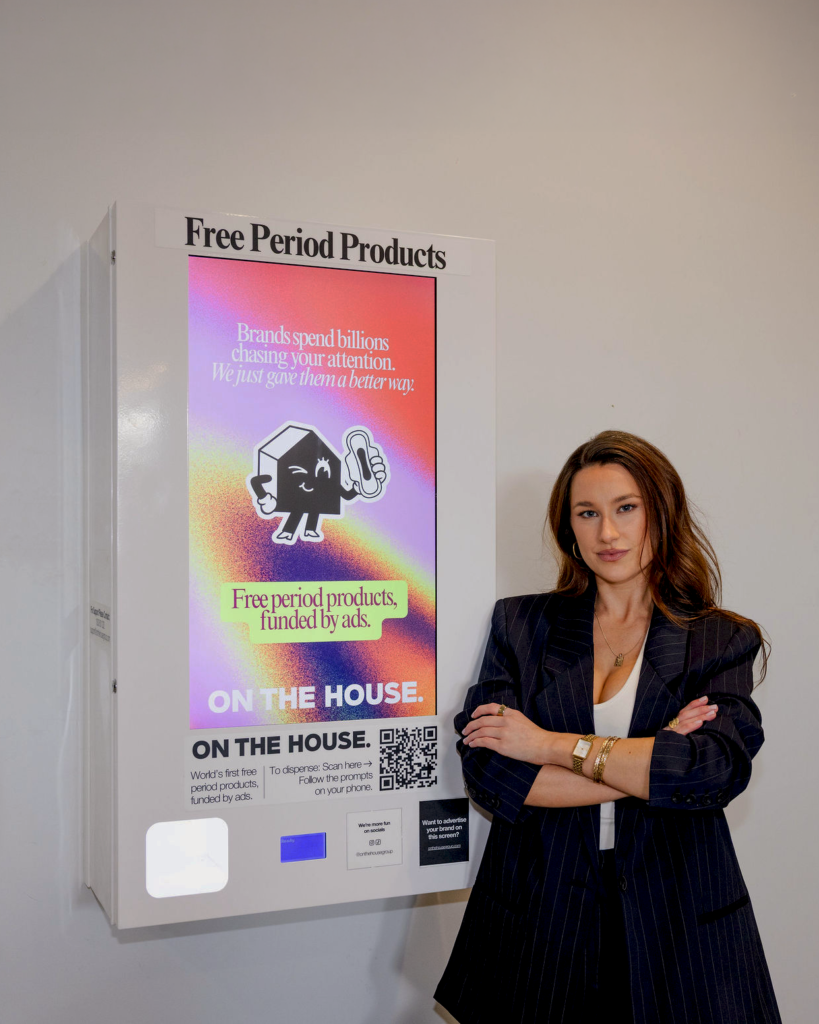
The model we landed on is highly practical: brands advertise on digital screens inside women’s bathrooms. Those advertising dollars fund free period products in the dispensers below. Women get exactly what they need. Brands get 76 seconds of real attention in a distraction-free environment. Venues get a better bathroom and the credit for providing it.
It works because it is not a charity. The ad pays for the product. The product earns trust, and that trust makes the ad inherently more valuable.
The Realities of Building a New Category
Today, we’ve grown from five initial dispensers in Queensland to 55 machines live across Brisbane, Sydney, Melbourne and the Gold Coast. But the journey hasn’t been without friction.
Founders who build something the world does not have a word for yet are dismissed a hundred times before they are understood. Selling a concept that has never existed before means your first job in every room is education, not pitching. It takes an enormous amount of grit to sit in that gap and keep going.
At ON THE HOUSE, we serve three completely interdependent customers: women, venues and brands. Getting that flywheel moving requires all three to believe in the vision simultaneously; a unique and humbling challenge. I’ve also had to navigate ‘outcome debt’. In startups, the instinct is always to move faster and ship sooner. But every shortcut is debt you pay back later with interest. Finding the balance between a ‘good’ outcome and a ‘finished’ one is an active, everyday negotiation.
To the Next Generation of Female Founders
If you are a woman looking to build something that disrupts the status quo, here is the advice I wish I had on day one:
- Don’t be conservative: Not in your investor pitches and not in your customer pitches. As women, we are often conditioned to shrink ourselves to save space. In the startup world, you are competing with people who do the exact opposite. Match their energy.
- Always ask, “Could this be bigger?”: It is entirely – and understandably – too easy to lock yourself into the first goal you set. Ask yourself every day if your vision could be larger than what you planned yesterday. The ceiling is usually much higher than you think.
- Design real guiding principles: Avoid platitudes. You need actual decision-making frameworks. When the hard tradeoffs come (and they always do), you need something concrete to reach for.
- Build a culture of radical integrity: Build a business where you could export every internal conversation as a PDF and your customer would smile reading it. Culture and integrity are not soft skills; they are structural pillars.
Looking Ahead: The End of Makeshift Solutions
We have a lot of work to do. We need governments to treat period product access as standard infrastructure. We need venues to normalise it as a baseline amenity. We need brands to realise redirecting ad spend towards channels which actually deliver for women isn’t just doing good, it’s responding to a clear and commercially proven demand. And we need to shift consumer behaviour so women don’t feel that they must buy period products at the supermarket and instead start expecting them to be free wherever they already are.
My immediate focus is geographic expansion across Australia, but our north star is 20,000 machines globally. We are building an entirely new advertising category that outperforms billboards, Meta, and Google ads on attention, trust and purchase intent.
Our long-term vision is for ON THE HOUSE to become the largest period product touchpoint in the world, reaching the 1.8 billion people who menstruate globally every month. That audience will become one of the most powerful attention networks on the planet. And by 2035, my goal is that the number of Australians forced to use makeshift solutions won’t be 3 in 5. It will be zero.
Remy Tucker is the Founder of ON THE HOUSE.